
See How Modeling and Simulation Is Used Across Industries
Multiphysics modeling and simulation drives innovation across industries and academia — as is evidenced by the many uses showcased in the technical papers and posters presented by engineers, researchers, and scientists at the COMSOL Conference each year.
Draw inspiration from the recent proceedings collected below, or, to find a specific presentation or filter by application area or conference year/location, use the Quick Search tool.
View the COMSOL Conference 2025 Collection

The activity focuses on improving the overall performance and design of a small-sized heat exchanger. This heat exchanger is designed to raise the temperature of a fluid (water), using tubular electric heaters. The device consists of a steel case with two hydraulic connections for fluid ... Read More

The Yellowstone Volcanic Complex (YVC) in Yellowstone National Park (Wyoming, USA) attracts intense geological interest, as it ranks as one of the largest active continental silicic volcanic fields worldwide. Despite extensive research on the region's high heat flow and abundant ... Read More
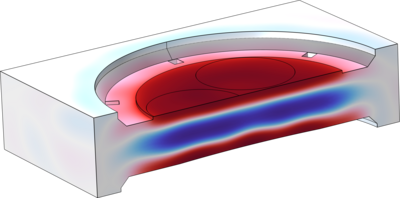
FT wind sensors measure wind speed and direction using an acoustic field superimposed on a flow field in an acoustic resonator equipped with three piezoelectric transducers. The study proposed here focuses on the acoustic resonance technology of a simplified wind sensor geometry, and how ... Read More

Mine hoists are significant capital investments, so their efficient, safe, and reliable operation are of vital importance to mining companies. ABB delivers numerous drum hoisting systems to underground mines in China, South Africa, as well as to Poland. ABB mine hoists are one of the ... Read More

As part of its research, the Group of Electrical Engineering-Paris (GeePs) uses COMSOL Multiphysics software for applications such as material modelling in Electrical Engineering, electromagnetic compatibility and Eddy current non-destructive testing (EC-NDT). EC-NDT is an easy-to-use ... Read More

The storage of CO2 in the sub-surface is seen as a technology that can contribute to the generally accepted goal of a de-carbonized society. As real field experiments are hardly feasible, many current studies utilize the capabilities of numerical modelling. Concerning the practical ... Read More
Pioneering Computational Models for the Built Environment Energy performance is becoming more important in the build environment. With better insulated buildings, the possibility of moisture problems and thermal bridges increases. There for, it is not only important to determine the ... Read More
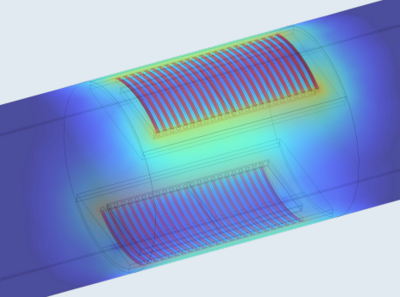
This study focuses on the design and optimization of a logging while drilling (LWD) tool with look-ahead detection capabilities, which is widely used in measuring formation resistivity and detecting formation boundaries ahead of the drill bit during oil and gas drilling operations. The ... Read More

The Reelwell Drilling Method (RDM) represents an innovative and energy-efficient approach to directional drilling (Rajabi et al. 2009; Belarde and Vestavik 2011; Breivik et al. 2020). RDM has been particularly successful in enhancing MPD and ERD. The technology enables constant well ... Read More

This study focuses on designing biomimetic leaf-like flow fields for co-electrolysis in solid oxide electrolysis cell (SOEC). The goal is to enhance overall performance in energy conversion processes. A three-dimensional SOEC model is developed using COMSOL to investigate the impact of ... Read More


