
Explore the innovative ways multiphysics simulation is being used worldwide to advance research
Multiphysics modeling and simulation drives innovation across industries and academia — as is evidenced by the many uses showcased in the technical papers and posters presented by engineers, researchers, and scientists at the COMSOL Conference each year.
Draw inspiration from the recent proceedings collected below, or, to find a specific presentation or filter by application area or conference year/location, use the Quick Search tool.
View the COMSOL Conference 2026 Collection
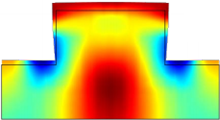
The ubiquitous commercial use of Lithium-Ion batteries (LIBs) has increased interest in their implementation into efficient energy storage systems for clean and renewable power sources and the electrical transportation industry. Unfortunately, LIBs are not yet technological mature to ... Read More

The discharge of an alkaline Zn anode involves the conversion of Zn metal to solid ZnO through the zincate ion. With the heterogeneous dissolution of Zn and mobility of zincate in the electrolyte, complex radial distributions of Zn and ZnO have been observed to occur in the anodes of ... Read More

Individual batteries have their own operational temperature ranges, which shall be respected to avoid both damaging of the cells and shortening of the cycle life. In terms of the Li-Ion cells, many of them do not function well at higher temperatures. Therefore, a better understanding of ... Read More

COMSOL Multiphysics was used to simulate the heat flux from battery cells via conjugate heat transfer physics which consist of laminar flow and heat transfer in solids and fluids. Laminar flow function was used to simulate natural convection of air within the sealed enclosure. Heat ... Read More
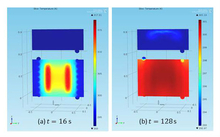
A design for the thermal management of the media used for packing Li-ion batteries used in hybrid and electric vehicles has been developed. The design satisfies all thermal and physical issues relating to the battery packs used in vehicles such as operating temperature range and volume, ... Read More

The performance and rechargeability of zinc-air batteries are found to be significantly influenced by the microstructure of the zinc anode [1]. It is evident that features such as porosity, connectivity, and spatial distribution of solid phases exert a considerable influence on ionic ... Read More

Failure of conventional lead-acid battery is attributed to degradation of solid active mass (PbO2 and PbSO4 ). A number of research efforts are underway worldwide to overcome degradation of active mass to improve the cycle life of lead-acid batteries. Soluble lead-acid flow battery ... Read More
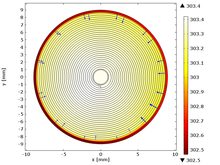
The characterization of Li-ion batteries is a relevant topic due to the recent developments in Electric Vehicles (EV’s) and Hybrid Electric Vehicles (HEV’s) applications. In order to manage these devices, accurate models are required. At NEXT ENERGY a two dimensional cell-level thermal ... Read More


