
Lorenzo Bortot, CERN, Switzerland
Engineers and physicists at CERN go to great lengths to ensure that the high-power superconducting magnets that maintain the circular trajectory of particles inside the Large Hadron Collider (LHC) do not revert to a resistive state, an event known as a quench. To understand and prevent quench events, Lorenzo Bortot, an electrical engineer and research fellow at CERN, used numerical simulation to develop a multiphysics, multiscale, and multirate representation of the electrodynamics and thermal evolution of a quench event.
Suggested Stories
Improving Gas Pipeline Squeeze-Off Standards with Numerical Simulation
Gas Technology Institute (GTI), a leader in natural gas research, development, and training, investigated industry ...

Predicting Blood Damage with Surrogate Modeling
Veryst developed a surrogate model to better understand the relationship between a nozzle and blood damage. Learn more ...
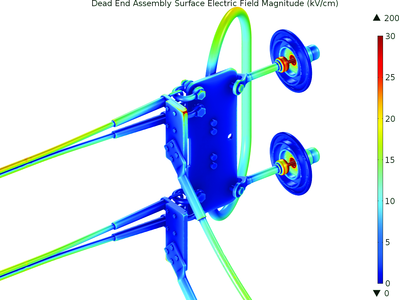
Enhancing Transmission Line Performance: Using Simulation to Optimize Design
Designing power transmission lines requires accounting for many factors: mechanical stress due to environmental ...
Making Biofuel a Cost-Effective, Renewable Source of Energy
Pyrolysis is a pre-commercial thermochemical process that converts renewable, plant-based materials such as wood into ...


