
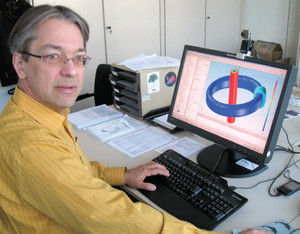
Harvey Buck, Roche Diagnostics Operations, Inc., Indianapolis, IN, USA
The test strips in glucose monitors, widely used by people with diabetes to maintain good health, are sensitive to chemical interferences and environmental conditions. The manufacturing process and electrode configuration of these strips also affects response accuracy. Researchers at Roche Diagnostics Operations, Inc. used multiphysics simulation to analyze the chemical reactions and voltage response in their glucometers.
Using COMSOL Multiphysics, Harvey Buck, principal scientist at Roche, investigated different configurations and materials used in the test strips. He analyzed the electrical response to an applied voltage during the chemical reaction catalyzed in a sample. Through numerical simulation, he predicted the sensitivity of electrical impedance measurements to mechanical properties of the sensor. He also optimized the electrode configuration, maximized sensitivity to cell fraction in a sample, and minimized sensitivity to manufacturing tolerances. These simulation results have given the Roche team a better understanding of their integrated sensor design for glucose monitoring.
Suggested Stories

Finding Buried Objects Using Seismic Surface Waves
Could spectral analysis of seismic surface waves help find a buried object? Learn about this novel method here.

Using Simulation to Guide mRNA Vaccine Production
In recent times, lipid nanoparticles have gained public attention for their use in mRNA vaccine production. Read how ...
3D Parametric Full Eye Model Gives 20+ Years of Better Vision
To correct presbyopia, researchers at Kejako, a medical device company in Switzerland, are developing a noninvasive ...
Current Transformer Design That Combines Finite Element Analysis and Electric Circuit Simulation
Transformers have been around for quite a while but their fundamentals are still being investigated by ABB in ...


