
Intel Optimizes an Electronic Device Component with Simulation
Juan C. Cervantes-Gonzalez, Intel Guadalajara Design Center, Mexico
As the demand grows for faster electronic devices in smaller packages, we need to develop optimized high-speed interconnects, which transfer the signal between components in electronic devices. Found in printed circuit boards (PCB), this integral design element in electronics packaging carries signals laterally and through the depth of PCBs, traversing many layers of metal and dielectric material. To satisfy these growing technology demands, interconnects must be designed smaller, more closely packed, and able to operate at higher frequencies.
To reduce the number of prototypes required to test new interconnect designs, engineers at the Intel Guadalajara Design Center developed an efficient computational design optimization method, combining full-wave electromagnetic simulation in COMSOL Multiphysics® software with a space-mapping (SM) algorithm implemented in MATLAB® software. Through their approach, an interconnect design can be quickly optimized, streamlining the design cycle and time to market of the latest high-speed interconnect technology.
Suggested Stories
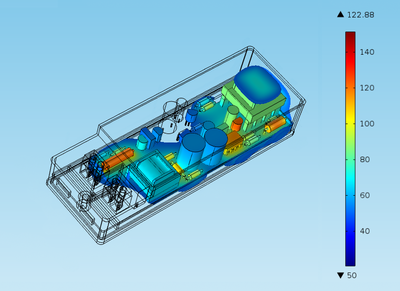
Keeping LEDs Cool Gets More Manageable Through Simulation
Light-emitting diodes (LEDs) offer many benefits over incandescent lighting, such as long life spans and high luminous ...
Keynote: The Role of FEA Simulations in Electrifying Aviation
In this keynote talk, Mustafa Baris Topçuoglu discusses aerospace company GKN Fokker Elmo's research- and customer ...

5 Real-World Examples of Modeling and Simulation for Food Safety
Consumer confidence in food safety reached a record low in 2024, making it important for companies to guarantee the ...
Lighting the Way for Improved Synchrotron Vacuum Chambers at RadiaSoft
One of the goals of the Argonne National Laboratory (ANL) is to increase the brightness of synchrotron beams for the ...


