
J. Leman
POWER Engineers, ID, USA
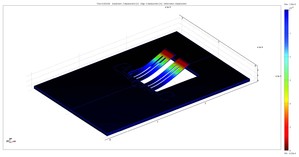
Designing power transmission lines requires accounting for many factors: mechanical stress due to environmental conditions and hardware loads, performance testing, and--of course--electrical analysis. Transmission line hardware contains both insulating and conducting assemblies. One common electrical phenomenon is called corona discharge, which occurs when electric fields near the surfaces of insulating assemblies and high-voltage conductors cause the surrounding air molecules to ionize. This can cause electromagnetic interference, visible light, energy losses, and audible noise. In a project to reduce corona discharge in transmission lines, Jon Leman, a senior project engineer at the consulting firm POWER Engineers, Inc. used COMSOL Multiphysics to model an insulator assembly. His team used their simulation to determine the electric field strength and electric potential around different surfaces of the transmission line hardware. They used their results to predict which areas were most susceptible to corona discharge, and gained valuable knowledge about how insulator assembly designs can be modified for better performance.
Suggested Stories
Easy and Accurate Measurement of Blood Viscosity
Microvisk Technologies develops and manufactures devices for measuring blood viscosity using the power of Micro ...
Simulating Printhead Unimorph Actuators at FUJIFILM Dimatix
FUJIFILM Dimatix, a top producer of commercial inkjet printheads, uses multiphysics simulation to develop MEMS ...
Keynote: Modeling Nanoscale Gas Behavior in Wafer Fabrication Systems
In this keynote talk from the COMSOL Conference 2025 Boston, Hanna Paddubrouskaya of Tokyo Electron US discusses how ...
Keynote: Electrochemical Modeling for Optimized Operating Strategies and Development of Automotive Cells
In this keynote talk from COMSOL Day: Battery Design, Nikolaos Papadopoulos of Porsche discusses how he is using ...


