
General Atomics Designs Helicon Antenna for Tokamak with Simulation
Humberto Torreblanca, General Atomics, USA
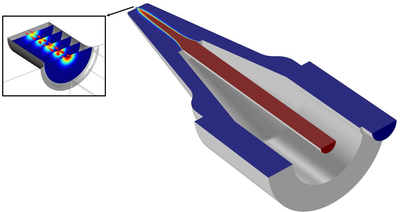
Built by engineers at General Atomics, the DIII-D tokamak needs to achieve temperatures that are 10 times hotter than the core of the Sun to achieve nuclear fusion. To accomplish this, a novel heating system using a helicon antenna that can inject 1 megawatt of RF power is being designed and built. Humberto Torreblanca, the DIII-D tokamak chief operator, and his team are using multiphysics simulation to model all aspects of the design, such as the magnetic field distribution inside and outside the tokamak vessel as well as the electric field distribution and RF losses of the helicon antenna.
Suggested Stories
Virtual Material Design in 3D Printing Makes Headway with Multiscale Modeling
The advantages of anisotropic properties in 3D printing materials have been difficult to exploit for product design, ...
Simulation Summit Panel: The Multiphysics Roadmap
Speakers from NVIDIA, Stanford University, and MathWorks, as well as COMSOL and moderator DE 24/7, discuss the future ...
Optimizing Hematology Analysis: When Physical Prototypes Fail, Simulation Provides the Answers
Hematology analysis, the analysis of a blood sample to determine a variety of hematological parameters, is a major ...
Multiphysics Software Models Mean Flow-Augmented Acoustics in Rocket Systems
Historically, difficulties in modeling and predicting combustion instability have led engineers to costly physical ...


