
NEXT ENERGY Analyzes Heat Transfer in Lithium-Ion Batteries
Gerd Liebig, Pamina Bohn, NEXT ENERGY EWE Research Centre for Energy Technology, Germany
Lithium-ion batteries, which have a tendency to degrade at high temperatures, must adhere to stringent regulations guaranteeing their ability to withstand operating temperature fluctuations. Researchers at NEXT ENERGY used heat transfer modeling to study whether high welding temperatures can create enough temperature propagation within cells to cause irreversible damage, such as electrolyte decomposition and capacity loss. They discovered that tab welding can, in fact, induce irreversible damage, but laser welding is significantly less detrimental.
Suggested Stories
Lighting the Way for Improved Synchrotron Vacuum Chambers at RadiaSoft
One of the goals of the Argonne National Laboratory (ANL) is to increase the brightness of synchrotron beams for the ...
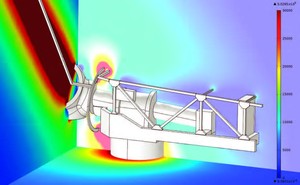
Lightning-Proof Wind Turbines
Søren Find Madsen, Global Lightning Protection Services A/S, Lejre, Denmark Global Lightning Protection Services A ...
Developing Ultrathin Dolby Atmos® Enabled Speaker Technology for Home Entertainment Systems
3D surround sound technology creates a premium and fully immersive audio experience for consumers. Dolby Laboratories ...
Producing Power, Protecting Fish with a Darrieus Water Turbine
Physixfactor used simulation to design a water turbine for use in coastal flood control structures in the Netherlands. ...


