
Simulation Helps Companies Assess Thermal Behavior of LED Devices
Aulis Tuominen and Mika Maaspuro
University of Turku
Turku, Finland
Toni Lopez
Philips Research
Eindhoven, The Netherlands
Sami Yllikäinen
Hella Lighting Finland Oy
Salo, Finland
Raimo Laitinen
Helvar Oy Ab
Karkkila, Finland
Light-emitting diodes (LEDs) offer many benefits over incandescent lighting, such as long life spans and high luminous efficiency, and they are environmentally friendly. One of the drawbacks, however, is that LEDs need to operate at the lowest possible temperatures and this must be carefully regulated.
Researchers at Business and Innovation Development Technology at the University of Turku in Finland have focused their attention on designing an efficient and inexpensive heat sink to regulate temperature. Simulation was crucial to their process as building prototypes is an expensive and time-consuming process.
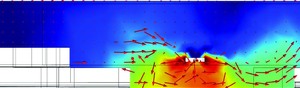
Large manufacturing companies, such as Philips and Hella Lighting, use simulation to improve their LEDs as well. Simulation in COMSOL Multiphysics allows companies to determine the effect of new materials on the thermal behavior of the LED lighting device before a sample of that new material is even required for testing.
Suggested Stories
Simulation Applications Streamline the Development of Electric Vehicle Motors
Engineers at Volkswagen Kassel build and distribute simulation applications that can be used to evaluate the strength ...
Restoration of Lake Water Environments
Human activity steals oxygen from natural water sources such as lakes and this oxygen-deficient water often contains ...

Multiphysics Analysis of a Burning Candle
Using COMSOL Multiphysics, AltaSim Technologies were able to predict the temperature distribution and flow pattern of ...
Fuel Cells Poised to Replace India’s Diesel Generators
Inefficient and potentially harmful diesel generators are still the prevailing method of decentralized power ...


