
Knowles Uses Simulation to Optimize Hearing Aid Performance
Brenno Varanda, Knowles Corporation, Illinois, USA
Nearly 20% of the United States population has some degree of hearing impairment. Despite the relative inconspicuousness and perceived simplicity of hearing aids, their development involves complex, time-consuming, and computationally expensive research. The hearing aid industry is in dire need of a simplified model that can expedite the design process and provide options to consumers quicker. Engineers at Knowles Corporation have achieved this using COMSOL Multiphysics®. Employing a simplified “black box” circuitry model of a receiver coupled to a model of the vibroacoustic system, they drastically reduced the time it takes to optimize performance and bring a prototype to market.
Suggested Stories
Manipulate and Control Sound: How Mathematical Modeling Supports Cutting-Edge Acoustic Metamaterials Research
Researchers at Duke University are using numerical modeling to develop metamaterial structures for acoustic cloaking. ...
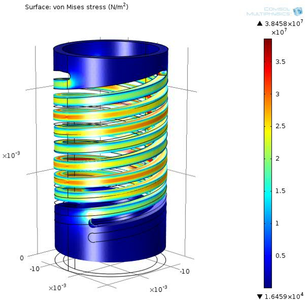
Meeting High-Speed Communications Energy Demands Through Simulation
The information and communication technology industry needs new energy-efficient devices that can keep up with the ...
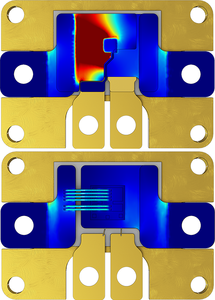
Innovative Packaging Design for Electronics in Extreme Environments
Power electronics appear in many everyday products, including smartphones, electronic car parts, and household ...

Designing the Sound Absorption of Microlattice Structures
Using numerical simulation, you can design microlattice structures with sound-absorbing properties, and then print ...


