
Clemson Simulates Electrode Setup for Dielectrophoresis
G. Zhang
Clemson U, SC, USA
J. Brcka, J. Faguet, E. Lee
Tokyo Electron, TX, USA
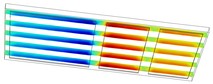
Dielectrophoresis (DEP) is a method of patterning cells and particles used in medical, electronics, and energy applications. When an electric field is applied to an array of cells or dielectric particles suspended in a medium, they become polarized, causing movement that reorganizes the particles. This is an efficient way to assemble materials layer by layer at the nanoscale, and is sometimes used in mass production of materials. Through a partnership between Clemson University and Tokyo Electron U.S. Holdings, Inc., researchers are analyzing unexpected particle rotation and alignments they have observed during cell patterning. They have used COMSOL Multiphysics models to understand cell patterns and material assembly; their simulations account for nonhomogeneous cell properties and electric field distortions, which they are analyzing to predict the influence of DEP force on this behavior.
Suggested Stories
Get a Quick Look at How Sonos Develops Innovative Smart Speakers
Innovative designs are typically not developed in one go. In this video, we meet Doug Button, distinguished audio ...
HPC-Enabled Simulation Aids in the Design of Customized High-Power Electrical Devices
Engineers at Block Transformatoren-Elektronik design custom coiled products, including transformers, power supplies, ...
Modeling the Electrochemistry of Blood Glucose Test Strips
Lifescan Scotland is a medical device company that designs and manufactures blood glucose monitoring kits for the ...
Increasing Lifespans of High-Power Electrical Systems
ABB Semiconductors increased the lifespan of an insulated-gate bipolar transistor (IGBT) using multiphysics ...


