
F. Curtis, J.D. Freels
Oak Ridge National Lab, TN, USA
In response to the increasing awareness of the risks associated with the proliferation of nuclear materials, the Global Threat Reduction initiative has called for research reactors currently using highly enriched uranium (HEU) fuel to be converted to low-enriched uranium (LEU) fuel. The High Flux Isotope Reactor (HFIR), located at Oak Ridge National Laboratory (ORNL), is one such reactor that uses HEU fuel.
Using multiphysics simulation, ORNL engineers are conducting researching and working toward a new design for the HFIR that will preserve the reactor's performance, minimize negative effects on operation efficiency, and ensure reactor safety once the reactor’s fuel has been converted. This process requires that highly accurate multiphysics analyses be conducted into the fluid-structure interaction (FSI) of the reactor’s fuel plates and that an understanding of how the new density of the LEU fuel will impact reactor performance is achieved. ORNL researchers developed a model of the fuel plate deflections in COMSOL Multiphysics that they validated against representative tests using core configurations similar to the HFIR. The model will be used to test new design possibilities and eventually help facilitate the reactor's conversion to LEU fuel.
Suggested Stories
Optimizing a CVD Process for a High-Performance Tungsten Material
Researchers at Forschungszentrum Jülich GmbH, Institute for Energy and Climate Research, and Max Planck Institute for ...
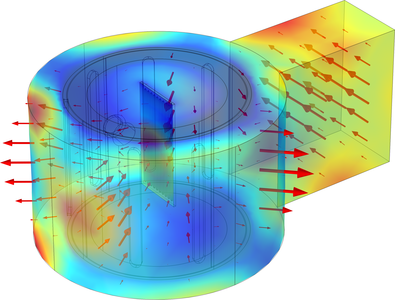
Developing a New Microreactor for Organic Synthesis Using Microwave Heating
The chemical reactions used to generate solvents and certain pharmaceuticals rely on organic synthesis, a process of ...
Compressing the Timeline to a Fusion Future
General Fusion has successfully designed and optimized a fusion demonstration machine with the help of multiphysics ...

Modeling Lined Rock Caverns for Underground Hydrogen Storage
Lined rock caverns can store hydrogen, but their safety depends on interactions between hydrogen gas, rock masses, and ...


