
Nels Jewell-Larsen,
Tessera Technologies, CA, USA
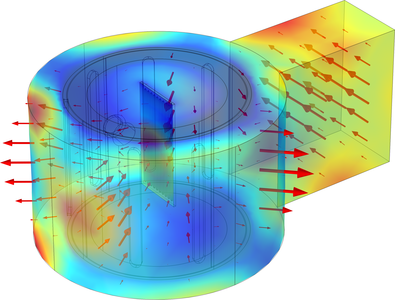
Removing heat from electronic devices is a necessity that up until now was achieved by rotary fans. Tessera, a company that delivers innovative miniaturization technologies and products for next-generation electronic devices, developed a replacement for rotary fans that can satisfy demanding space and noise constraints. They designed a silent air cooling system that uses an electric field to ionize and move nitrogen molecules in ambient air, resulting in an air flow that cools the device.
To create their model, Tessera turned to simulation using the CFD and AC/DC modules of COMSOL. Their simulation needed to take electrostatics, charge generation and transport, fluid dynamics, and heat transfer into account and model all this phenomena together. After key aspects of the blower were designed in COMSOL Multiphysics, they were ported over to a CAD software to design the rest of the system. The end result was a reliable, compact unit that operates at less than 15 dBA, which is below the average threshold for hearing.
Suggested Stories

Designing the Sound Absorption of Microlattice Structures
Using numerical simulation, you can design microlattice structures with sound-absorbing properties, and then print ...
Developing a New Microreactor for Organic Synthesis Using Microwave Heating
The chemical reactions used to generate solvents and certain pharmaceuticals rely on organic synthesis, a process of ...

5 Real-World Examples of Modeling and Simulation for Food Safety
Consumer confidence in food safety reached a record low in 2024, making it important for companies to guarantee the ...
Training Uncrewed Underwater Vehicles for Visualization of Subsurface Structures
By using simulation apps and machine learning techniques, USM researchers are laying the groundwork for UUVs capable ...


