
Francesca Magionesi
INSEAN
Italy
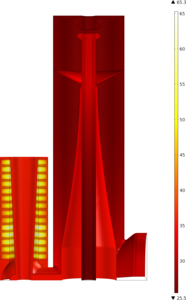
There has been a recent move towards utilizing bulbous bows on ships to house different types of sonar systems, but it is not definite how much structural vibration might interfere with the functioning of a transducer array inside the sonar dome. INSEAN, the National Institute for Studies and Experiments of Naval Architecture in Italy, needed a way to simulate what is happening when the turbulent boundary layer interacts with the bulbous bow in order to determine how much self-noise this creates.
They first created a small-scale model to capture the turbulent boundary layer excitation and that gave them a full-scale fluid load expression. They then created a full-scale model within COMSOL Multiphysics, taking the complexity of the composite material used for the bulbous bow and the turbulent boundary layer load into account. LiveLink™ for Pro/ENGINEER® enabled the team to bring CAD data for the different parts of the bulbous bow into COMSOL Multiphysics.
Suggested Stories
Developing Ultrathin Dolby Atmos® Enabled Speaker Technology for Home Entertainment Systems
3D surround sound technology creates a premium and fully immersive audio experience for consumers. Dolby Laboratories ...
Elevating the Performance of Ionization Gauges with Simulation
Semiconductor manufacturing and particle physics research depend on high-vacuum or ultra-high-vacuum (HV/UHV) ...
Doubling Beam Intensity Unlocks Rare Opportunities for Discovery at Fermi National Accelerator Laboratory
Behind the discovery of the most fundamental and rare physical processes within our universe is powerful technology, ...
Behind the Rumble and Roar of Mahindra Motorcycles
Optimization is a subtle and delicate art, especially when it comes to motorcycles. Regulatory requirements on pass-by ...


