
Marco Barink, Erica Coenen, TNO, Netherlands
The advantages of anisotropic properties in 3D printing materials have been difficult to exploit for product design, limited by material manufacturing and production methods. However, additive manufacturing is opening doors to material fabrication, allowing engineers to virtually design varying material properties into a single product. At the Netherlands Organization for Applied Scientific Research (TNO), researchers investigated virtual material design using multiphysics simulation and multiscale modeling.
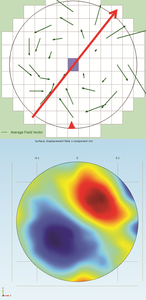
To develop a procedure for designing anisotropy into 3D-printed structures, the researchers used COMSOL Multiphysics to study mechanical behavior in a unit cell, control material properties and the orientation of anisotropic fibers, and optimize local material distribution to achieve desired overall properties. To study material design on a larger scale, they extracted material parameters from the unit cell to include in a model of a full-scale 3D-printed object, and successfully applied methods of fully-coupled multiscale modeling to geometry and material design in several different applications.
Suggested Stories
Keynote: Electroacoustics and FEA: A Long and Successful Relationship
In the world of electroacoustics, finite element analysis (FEA) has been in use for decades. The COMSOL ...

6 Examples of Simulation-Driven Loudspeaker Development
From headphones for virtual reality gaming to powerful transducers for hearing aids, here are 6 examples of ...

Silent Air Cooling: A New Approach to Thermal Management
Removing heat from electronic devices is a necessity that up until now was achieved by rotary fans. Tessera, a company ...
Modeling of Complex Physics Speeds Chip Development
With technological advancements accelerating so rapidly, more powerful computer chips are needed to meet the high ...


