
Marco Barink, Erica Coenen, TNO, Netherlands
The advantages of anisotropic properties in 3D printing materials have been difficult to exploit for product design, limited by material manufacturing and production methods. However, additive manufacturing is opening doors to material fabrication, allowing engineers to virtually design varying material properties into a single product. At the Netherlands Organization for Applied Scientific Research (TNO), researchers investigated virtual material design using multiphysics simulation and multiscale modeling.
To develop a procedure for designing anisotropy into 3D-printed structures, the researchers used COMSOL Multiphysics to study mechanical behavior in a unit cell, control material properties and the orientation of anisotropic fibers, and optimize local material distribution to achieve desired overall properties. To study material design on a larger scale, they extracted material parameters from the unit cell to include in a model of a full-scale 3D-printed object, and successfully applied methods of fully-coupled multiscale modeling to geometry and material design in several different applications.
Suggested Stories
Making Predictions in Additive Manufacturing with Simulation Apps
Engineers at the Industrial Technology Research Institute (ITRI) can predict the performance of laser powder bed ...
Optimizing 3D Printing Techniques with Simulation Apps
3D printing has recently revolutionized manufacturing techniques, influencing countless industries and products. The ...
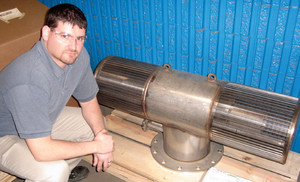
The Science of Water Screening
Johnson Screens® are the manufacturers of steel screens that impede debris from lakes and rivers from entering pipes ...
Fine-Tuning the Factory: A Simulation App Helps Optimize an Additive Manufacturing Facility
Britain's Manufacturing Technology Centre, along with partners in the aerospace sector, has built an on-site powder ...


