
In accordance with our Quality Policy, COMSOL maintains a library of hundreds of documented model examples that are regularly tested against the latest version of the COMSOL Multiphysics® software, including benchmark problems from ASME and NAFEMS, as well as TEAM problems.
Our Verification and Validation (V&V) test suite provides consistently accurate solutions that are compared against analytical results and established benchmark data. The documented models below are part of the COMSOL Multiphysics® software’s built-in Application Libraries. They include reference values and sources for a wide range of benchmarks, as well as step-by-step instructions to reproduce the expected results on your own computer. You can use these models not only to document your software quality assurance (SQA) and numerical code verification (NCV) efforts, but also as part of an in-house training program.
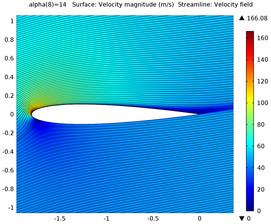
This model simulates the flow around an inclined NACA 0012 airfoil at different angles of attack using the SST turbulence model. The results show good agreement with the experimental lift data of Ladson and the pressure data of Gregory and O’Reilly. Read More

This model is a benchmark for three-phase flow commonly used in food processing, pharmaceutical industry, and chemical processing. The results are validated against data reported in the literature. A gas bubble rises through two layers of liquid, a lighter liquid resting on top of a ... Read More
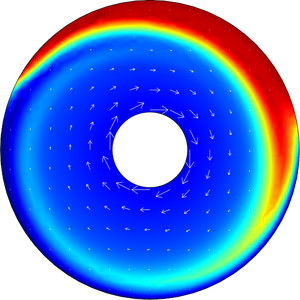
Liquid-solid mixtures (suspensions) are important in a variety of industrial fields, such as oil and gas refinement, paper manufacturing, food processing, slurry transport, and wastewater treatment. Several different modeling approaches have been developed by the CFD community, ranging ... Read More
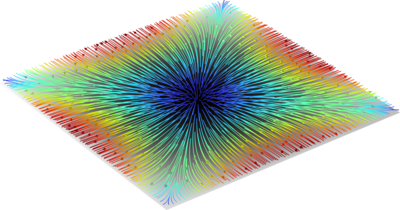
This example describes how to simulate the flow of a thin film of fluid in the gap between two rectangular plates, one of them with a porous facing, when the fluid is squeezed as a consequence of the relative motion between the plates. The model accounts for the ingress and egress of ... Read More
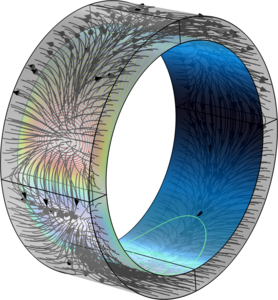
This example describes how to simulate the self-lubricating phenomenon of a liquid lubricant in a journal bearing. A porous bushing is press-fitted to a bearing and saturated with a lubricant. It acts as a reservoir for the redistribution of the thin film of lubricant between regions of ... Read More
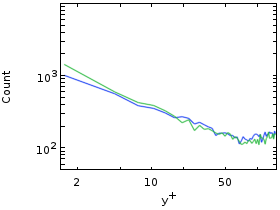
In this benchmark model, solid particles are released in a fully developed turbulent channel flow. The particles are subjected to a drag force that includes contributions from the fluid turbulence, implemented using a Continuous Random Walk (CRW) model. Because the turbulence in the ... Read More
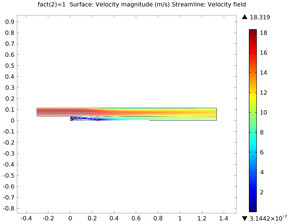
The backward facing step is an interesting case for studying the performance and solution strategy of a turbulence model. In this case, the flow is subjected to a sudden increase of cross-sectional area, resulting in a separation of flow starting at the point of expansion. Spatial ... Read More
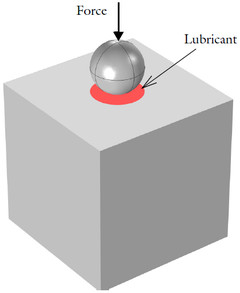
This benchmark model computes the transient pressure distribution and film height in a squeeze film bearing for lubrication in a nonconformal conjunction of a solid sphere and an elastic wall separated by a lubricant film. This model solves the benchmark case of hydrodynamic interaction ... Read More

In this model the high speed turbulent gas flow in a converging and diverging nozzle is modeled using the High Mach Number Flow interface. The diffuser is transonic in the sense that the flow at the inlet is subsonic, but due to the contraction and the low outlet pressure, the flow ... Read More
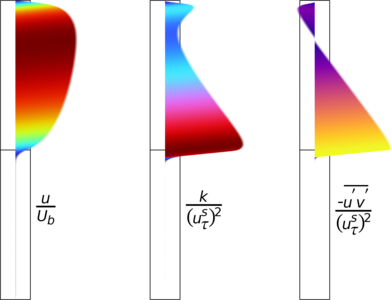
This setup demonstrates how the characteristics of turbulent flow in a channel are modified by the presence of an adjacent porous region. Asymmetric velocity profiles, higher turbulence levels, and higher friction coefficients both at the solid wall and the fluid-porous interface are ... Read More


