
In accordance with our Quality Policy, COMSOL maintains a library of hundreds of documented model examples that are regularly tested against the latest version of the COMSOL Multiphysics® software, including benchmark problems from ASME and NAFEMS, as well as TEAM problems.
Our Verification and Validation (V&V) test suite provides consistently accurate solutions that are compared against analytical results and established benchmark data. The documented models below are part of the COMSOL Multiphysics® software’s built-in Application Libraries. They include reference values and sources for a wide range of benchmarks, as well as step-by-step instructions to reproduce the expected results on your own computer. You can use these models not only to document your software quality assurance (SQA) and numerical code verification (NCV) efforts, but also as part of an in-house training program.
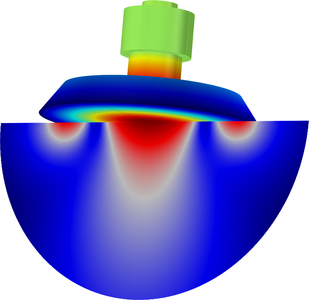
A tonpilz transducer is used for relatively low frequency, high power sound emission. It is one of the popular transducer configurations for SONAR applications. The transducer consists of piezoceramic rings stacked between a head mass and a tail mass which are connected by a central ... Read More
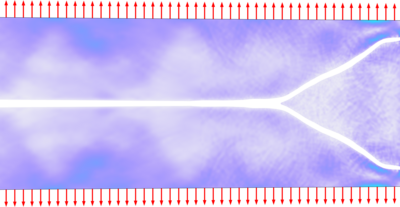
In this example, a benchmark problem in dynamic fracture of brittle materials is analyzed using the AT1 phase-field damage model. An instantaneous tensile load is applied to a planar tension specimen with a pre-existing crack. Initially, the crack propagates perpendicular to the loading ... Read More
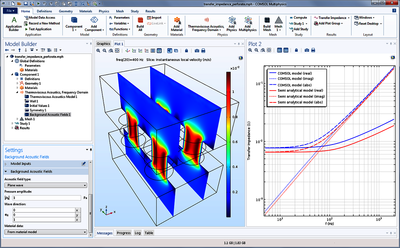
Perforates are plates with a distribution of small perforations or holes. They are used in muffler systems, sound absorbing panels, and in many other places as liners, where it is important to control attenuation precisely. As the perforations become smaller and smaller, viscous and ... Read More
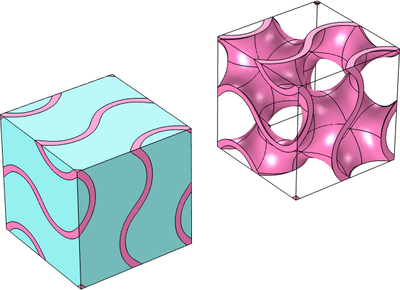
In this example, the homogenized elastic and thermal properties of a composite material based on a triply periodic minimal surface (TPMS) are computed. A gyroid TPMS-based unit cell is subjected to periodic boundary conditions to get the homogenized material properties. The effects of ... Read More
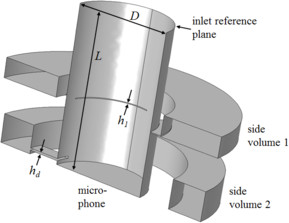
This is the model of an occluded ear canal simulator (a generic 711 coupler). Besides certain details the geometry corresponds to the Brüel & Kjær Ear Simulator Type 4157. The real life couplers are used for simulating the acoustics of a standardized human ear canal and can be used ... Read More
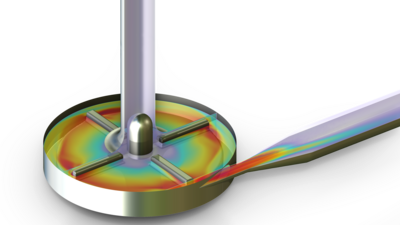
In this benchmark model for blood flow in a centrifugal pump, simulations are performed for several flow rates and pump speeds. The modeled geometry is taken from the FDA’s Computational Round Robin and the results are in good agreement with the experimental data. The computed shear ... Read More
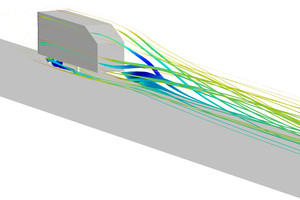
The Ahmed body represents a simplified, ground vehicle geometry of a bluff body type. Its shape is simple enough to allow for accurate flow simulation but retains some important practical features relevant to automobile bodies. This model describes how to calculate the turbulent flow ... Read More
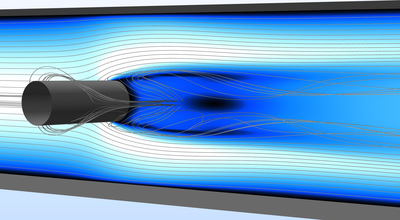
This example simulates 3D unsteady laminar flow past a cylinder in a channel. The inflow velocity profile is time-varying. The lift and drag coefficients are computed, and results show good agreement with those published in the literature. Read More
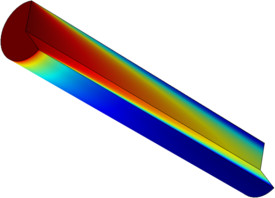
Chemical engineering students can model a nonideal tubular reactor, including radial and axial variations in temperature and composition, and investigate the impact of different operating conditions with this easy-to-use app. The process described by the Tubular Reactor with ... Read More
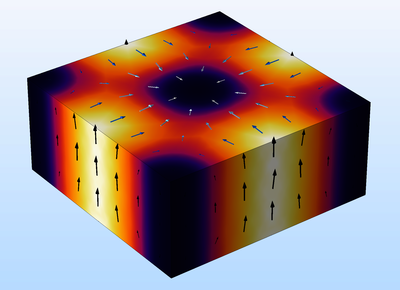
A classic benchmark example in computational electromagnetics is to find the resonant frequency and Q-factor of a cavity with lossy walls. Here, models of rectangular, cylindrical, and spherical cavities are shown to be in agreement with analytic solutions. Read More


