
The Application Gallery features COMSOL Multiphysics® tutorial and demo app files pertinent to the electrical, structural, acoustics, fluid, heat, and chemical disciplines. You can use these examples as a starting point for your own simulation work by downloading the tutorial model or demo app file and its accompanying instructions.
Search for tutorials and apps relevant to your area of expertise via the Quick Search feature. Note that many of the examples featured here can also be accessed via the Application Libraries that are built into the COMSOL Multiphysics® software and available from the File menu.
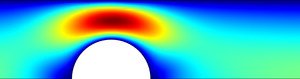
Many complex fluids of interest exhibit a combination of viscous and elastic behavior under strain. Examples of such fluids are polymer solutions and melts, oil, toothpaste, and clay, among many others. The Oldroyd-B fluid presents one of the simplest constitutive models capable of ... Read More
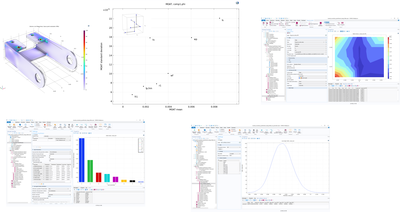
This example demonstrates how to use the Uncertainty Quantification Module by running a series of uncertainty quantification studies for a steel bracket. This type of bracket can be used to install an actuator that is mounted on a pin placed between the two holes in the bracket arms. ... Read More
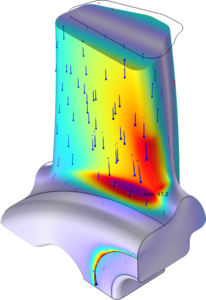
This tutorial uses the submodeling technique to accurately resolve the stress concentrations in a wheel rim. First a global model is solved to obtain the displacements, which are then used as boundary conditions in a local model of the region where the stress concentrations occur. Read More
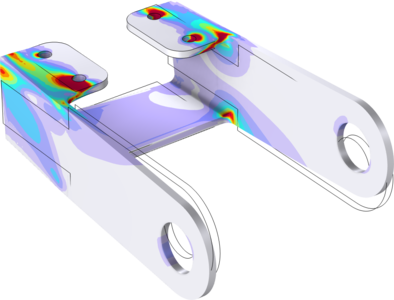
The bracket model tutorials are used as an introduction to the features and functionality within the Structural Mechanics Module. The following features are introduced: The following features are introduced: The fundamentals: static linear analysis Parametric study Including initial ... Read More
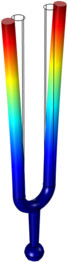
This app demonstrates the following: Playing a sound at a specific computed frequency Selecting different materials from a combo box Visualizing material appearance, color, and texture Choice of three different user interface layouts for computer, tablet, or smartphone Custom ... Read More
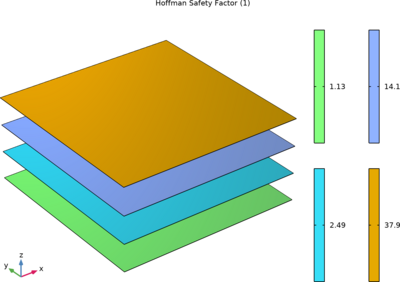
Laminated shells made of carbon fiber reinforced polymer (CRFP) are common in a large variety of applications due to their high strength-to-weight ratio. The widespread attention to laminated shells is due to their diverse applications in aerospace, marine, automotive, and various ... Read More
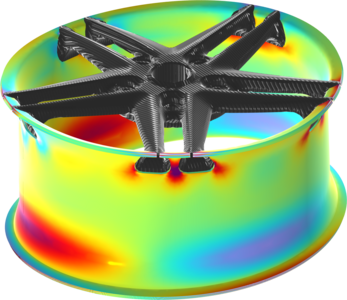
Nowadays, there is a trend to manufacture wheel rim made up of a composite material instead of aluminum. The primary reason is to have lower values of unsprung mass which leads to faster response time and thus better acceleration, braking and cornering performances. Typically a carbon ... Read More
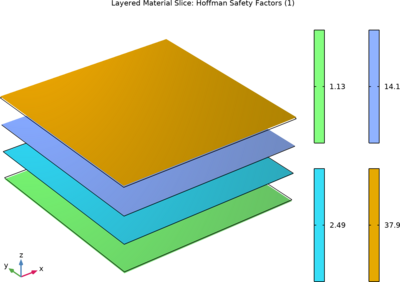
Laminated composite shells made of carbon fiber reinforced polymer (CFRP) are common in a large variety of applications due to their high strength-to-weight ratio. Evaluation of the structural integrity of a laminated composite shell for a set of applied loads is necessary to make the ... Read More
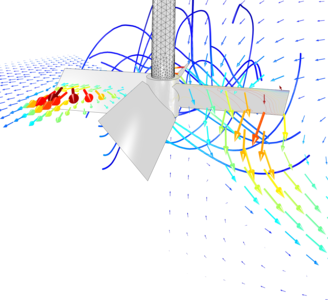
This model shows how to use simulations to predict power numbers with Power Law fluids in a mixer. It simulates the behavior of flow in a flat bottom tank with a single four-blade pitched impeller. The flow was modeled as laminar and the frozen rotor approach was used to solve the ... Read More
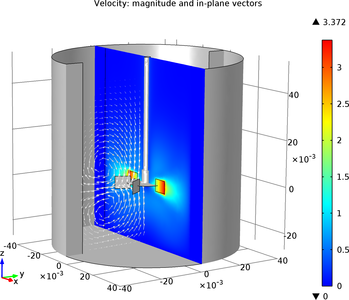
This model provides you with tools to build a variety of mixers by combining two common types of vessels with two types of impellers. The mixers are baffled flat and dished bottom vessels with either pitched blade impellers or Rushton turbines. The model includes three examples using the ... Read More