Electrical | Posted on
May 17th, 2013 by
Laura Bowen
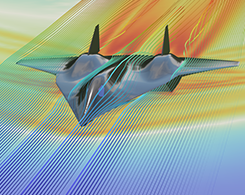
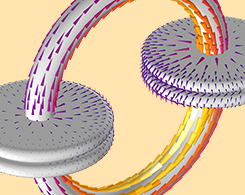
Magnetic levitation, or maglev, involves suspending materials with magnetic fields. When gravity, acceleration, and other forces weigh down on an object, they can all be counteracted by magnetic pressure. Some uses that may appear to go completely against nature can actually be explained by fundamental science.
Read more on: Unexpected Uses of Magnetic Levitation
Fluid | Posted on
May 16th, 2013 by
James Ransley
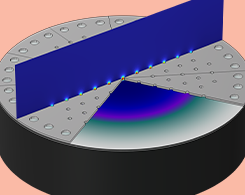
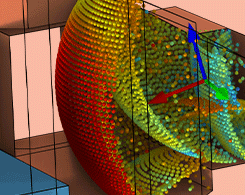
Vacuum technology has many important applications, from semiconductor device and MEMS fabrication, to vacuum coatings for corrosion protection, optical films, and metallization. The new Molecular Flow Module provides vacuum engineers with previously unavailable tools for modeling gas flows within vacuum systems.
Read more on: Molecular Flow Module: Simulate Rarefied Gas Flows in Vacuum Systems
News | Posted on
May 15th, 2013 by
Lorant Olasz
Starting with the release of COMSOL Multiphysics® 4.3b you can work with multiphysics simulations right from the user interface of the Autodesk® Inventor® CAD system. Called the One Window interface, this functionality is available with LiveLink™ for Inventor®. The result of the work by our external interfaces and integrations development team, the One Window interface, is a completely new environment for simulations that are embedded in the Inventor® user interface. It contains the Model Builder, Settings, and all other views you are familiar with when modeling in the COMSOL Desktop™.
Read more on: Multiphysics Simulations inside the Autodesk® Inventor® User Interface
Events | Posted on
May 14th, 2013 by
Nandita Roche
Are you an engineer under the age of 35, located somewhere in the Asia-Pacific region? If the answer is yes, you are eligible to enter the All IEEE-R10 Young Engineers’ Humanitarian Challenge 2013. The contest aims to engage young engineers to solve humanitarian problems using technology and entrepreneurial leadership. Many innovative project ideas have been submitted to this engineering contest in the past, and the winners have received funding to implement them. This year it could be your project that provides the solution to a humanitarian challenge.
Read more on: Asia-Pacific Engineering Contest with a Cause Hosted by IEEE
Conference | Posted on
May 13th, 2013 by
Nandita Roche
If you are following this space, you have probably heard us talk about the upcoming users’ conference. Some of you might still be unsure of what this event is all about and what it can offer you, so we’ve put together a “Top 5″ list of reasons why you should attend the COMSOL Conference 2013. The conference has a wide and varied range of offerings. Unlike a lot of conferences out there, you don’t have to present a paper to attend ours (although we do still encourage it, of course). As a result, over the years, we have seen participants come to our conferences for a variety of needs.
So here they are, our Top 5 Reasons to Attend the COMSOL Conference 2013:
Read more on: Top 5 Reasons to Attend the COMSOL Conference 2013
Mechanical | Posted on
May 10th, 2013 by
Pawan Soami
The new Multibody Dynamics Module provides engineers with an advanced set of tools to design and optimize mechanical systems to reduce product development costs. This module enables simulation of an assembly of flexible and rigid bodies, along with physical phenomena like structural, heat, electrical, and others. One of the key capabilities included in this module is an easier and faster way of building connections between different bodies using various types of predefined Joints.
The objective of multibody analysis is to find critical areas of a system to perform more detailed component-level structural analysis. Multibody analysis also gives insight into the system dynamics, forces experienced by segments of the structure, and stresses generated in flexible components leading to failure due to large deformation or fatigue.
Read more on: Simulate Mechanical Systems with the Multibody Dynamics Module
Tips & Tricks | Posted on
May 9th, 2013 by
Andrew Griesmer
Swept meshing is a geometry discretization technique available in COMSOL Multiphysics for specific types of geometries, including thin geometries, geometries with bends, and models with little or no variation in a specific direction. A swept mesh starts at a source boundary and sweeps along to a specified destination boundary. In previous versions of COMSOL Multiphysics, the source and destination boundaries generally needed to be specified by the user. However, in the latest release, COMSOL Multiphysics version 4.3b, the swept mesh has become more automated, minimizing the number of source and destination boundaries manually defined.
Read more on: Sweep Your Meshes with Ease
Electrical | Posted on
May 8th, 2013 by
Daniel Smith
In a paper titled “Choosing a Gate Dielectric for Graphene Based Transistors” the applications of a semiconducting form of graphene are examined. As we have seen before, single-layer graphene is not a semiconductor, it is a zero band gap conductor (a semimetal). Efforts are well underway to introduce band gaps to graphene, which would make it semiconducting with a room temperature mobility an order of magnitude higher than silicon. The race is already underway to find applications for such a material once the remaining technical challenges have been overcome. An application of semiconducting graphene is the design of next-generation, fast switching semiconductor metal oxide field effect transistors (MOSFETs).
Read more on: The Graphene Revolution: Part 5
Electrical | Posted on
May 7th, 2013 by
Bjorn Sjodin
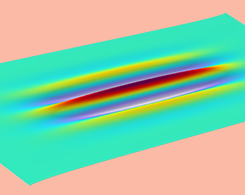
The new COMSOL Multiphysics Wave Optics Module provides engineers with a great set of features for designing their simulations. One of the new capabilities included in this module is the groundbreaking Beam Envelope Method for electromagnetic full-wave propagation. We hope this feature will become instrumental to the optics community.
Read more on: Taking Care of Fast Oscillations with the Wave Optics Module
Tips & Tricks | Posted on
May 6th, 2013 by
Andrew Griesmer
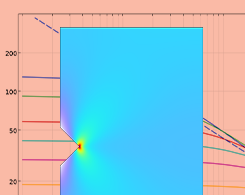
Our newest release, COMSOL Multiphysics version 4.3b, contains so many new modules and features, certain additions might get lost in the fray. One addition to the COMSOL Multiphysics base package we don’t want you to miss is the ability to create 2D models from cross sections of 3D geometries. This easy-to-use feature allows engineers to simplify the model, gain understanding of and fine-tune parameters, and dramatically reduce simulation time.
Read more on: Creating 2D Models from 3D Geometries in COMSOL Multiphysics