
The Application Gallery features COMSOL Multiphysics® tutorial and demo app files pertinent to the electrical, structural, acoustics, fluid, heat, and chemical disciplines. You can use these examples as a starting point for your own simulation work by downloading the tutorial model or demo app file and its accompanying instructions.
Search for tutorials and apps relevant to your area of expertise via the Quick Search feature. Note that many of the examples featured here can also be accessed via the Application Libraries that are built into the COMSOL Multiphysics® software and available from the File menu.
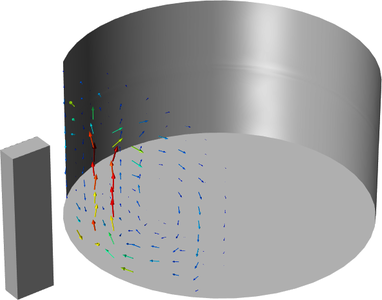
This is a tutorial how to set up electric machinery in 3D using a combination of the magnetic fields and magnetic fields no currents interfaces. Read More
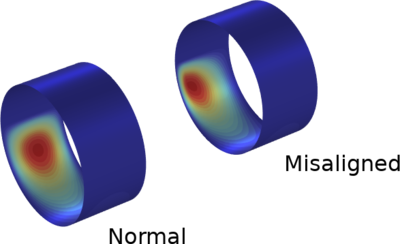
In this example, a rotor supported on two hydrodynamic bearings is analyzed. An eccentric disk located between the two bearings causes the rotor to whirl. One of the bearings is misaligned with the axis of the rotor. The Beam Rotor with Hydrodynamic Bearing interface in the ... Read More
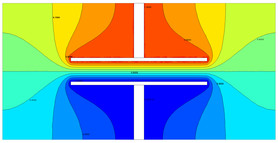
A capacitor, in its simplest form, is a two terminal electrical device that stores electric energy when a voltage difference is applied across the terminals. The stored electric energy is proportional to the applied voltage squared and is quantified by the capacitance of the device. This ... Read More
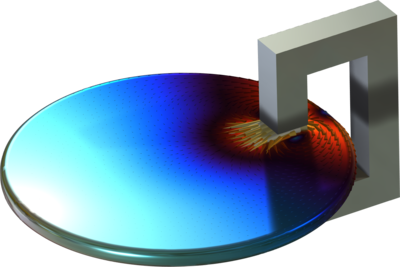
A magnetic brake consists of a permanent magnet, which induces currents in a rotating copper disk. The resulting eddy currents interact with the magnetic flux to produce Lorentz forces and subsequently a braking torque. This 3D problem is solved using a stationary formulation for the ... Read More
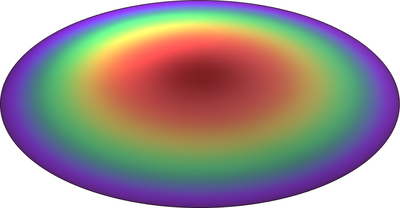
This tutorial shows how to evaluate the harmonic response of a structure with a moderately nonlinear behavior. A nonlinear problem can only be solved using time-domain analysis. A way to speed up the computation is to use a linearized frequency response analysis to provide good initial ... Read More
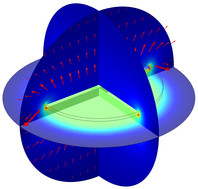
A typical capacitor is composed of two conductive objects with a dielectric in between them. A voltage difference applied between these objects results in an electric field between them. This electric field exists not just directly between the conductive objects, but extends some ... Read More

This example considers the natural convection of air above a smoldering incense stick. This kind of flow often shows a transition from laminar to turbulent which is nicely visualized by the smoke produced by the slow burning of the incense. The model uses the Nonisothermal Flow, LES RBVM ... Read More
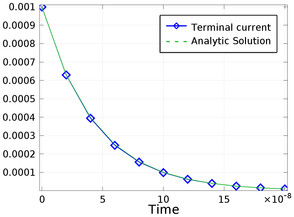
A transient model of a capacitor is solved in combination with an external electrical circuit. The finite element model of the capacitor is combined with a circuit model of a voltage source and a resistor. A step change in voltage is applied, and the transient current through the ... Read More
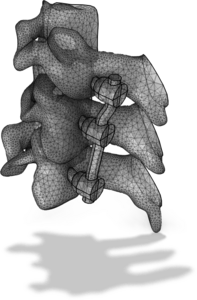
Follow this tutorial series to learn about how to work with imported surface meshes. The instructions detail how to import STL files of three vertebrae and two intervertebral discs as well as how to repair holes, misaligned mesh vertices, and intersecting elements. It further ... Read More
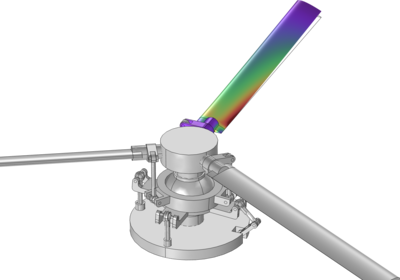
This model illustrates the operation of a swashplate mechanism used in helicopters to translate the input of helicopter flight control into the motion of the rotor blades, and hence controls the orientation of the rotor blades. In this model, the rotor blades are modeled as either rigid ... Read More