
The Application Gallery features COMSOL Multiphysics® tutorial and demo app files pertinent to the electrical, structural, acoustics, fluid, heat, and chemical disciplines. You can use these examples as a starting point for your own simulation work by downloading the tutorial model or demo app file and its accompanying instructions.
Search for tutorials and apps relevant to your area of expertise via the Quick Search feature. Note that many of the examples featured here can also be accessed via the Application Libraries that are built into the COMSOL Multiphysics® software and available from the File menu.

This model demonstrates how to set up a fully coupled poroviscoelastic model of biological tissues. The model is benchmarked by simulating a cyclic uniaxial tension–compression test on human brain tissue. Read More
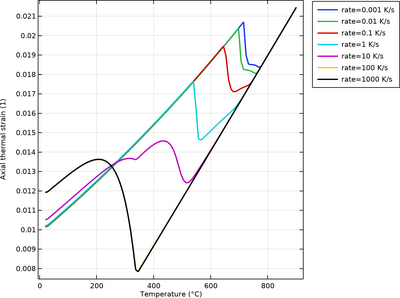
In this example, phase transformation data and phase material properties are imported from JMatPro, and used to compute CCT curves. Dilatometry curves (axial thermal strain) are computed across a range of cooling rates. Read More
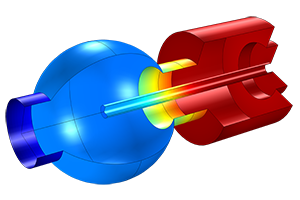
This model shows how to simulate the time-dependent adsorption and desorption of water in a vacuum system at low pressures. The water is introduced into the system when a gate valve to a load lock is opened and the subsequent migration and pumping of the water is modeled. Read More

Basin-type insulators are essential components in Gas-Insulated Metal-Enclosed Switchgear (GIS). During manufacturing, the epoxy resin curing process can generate residual stresses that may lead to crack formation. Over time, such cracks can trigger partial discharges, degrading the ... Read More
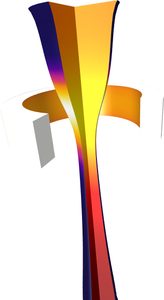
This example is about the modeling of the fiber drawing process. Thermal fiber drawing is a process in which a comparatively thicker structure is heated and drawn into extended lengths of microstructured fiber. This process is done by passing them through the furnace and pulling them ... Read More
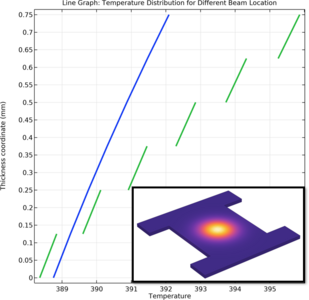
This example uses the thermal expansion of a laminated composite shell model to demonstrate the use of the feature Thermal Contact, Interface, applied on interfaces between layers in a laminated composite shell. The first study is computed neglecting this additional thermal resistance in ... Read More
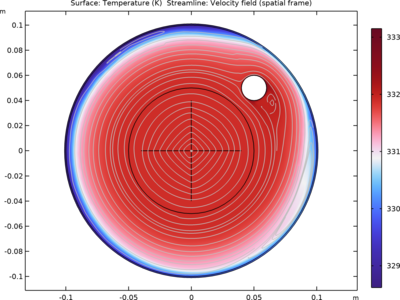
This model illustrates the modeling of temperature distribution in a simplified mixer. Read More
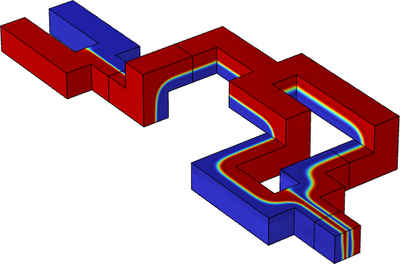
This example models a split-and-recombine mixer channel in which a tracer fluid is introduced and mixed by multilamination. Diffusion is removed from the model using an extremely low diffusion coefficient so that any numerical diffusion can be studied in the lamination interfaces. The ... Read More
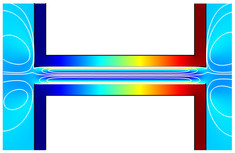
This model is a benchmark model for the Slip Flow interface. It is based on both analytic and numeric calculations. Air at atmospheric pressure flows through a conducting micro-channel connecting two reservoirs maintained at different temperatures. A flow between the two reservoirs ... Read More
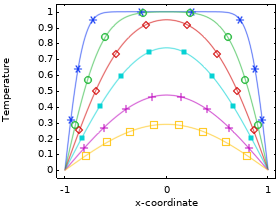
This simple example covers the heating of a finite slab and how the temperature varies with time. We will set up the problem in COMSOL Multiphysics after which we compare the solution to the analytical solution. Read More


