
The Application Gallery features COMSOL Multiphysics® tutorial and demo app files pertinent to the electrical, structural, acoustics, fluid, heat, and chemical disciplines. You can use these examples as a starting point for your own simulation work by downloading the tutorial model or demo app file and its accompanying instructions.
Search for tutorials and apps relevant to your area of expertise via the Quick Search feature. Note that many of the examples featured here can also be accessed via the Application Libraries that are built into the COMSOL Multiphysics® software and available from the File menu.
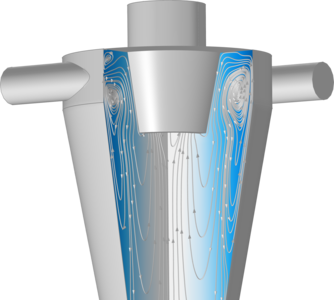
Cyclones are used in a variety of applications ranging from the mining industry to vacuum cleaners. The flow in a cyclone is characterized by a very strong swirl, which makes it difficult to simulate. In this tutorial example, the v2-f turbulence model is used to simulate the flow in a ... Read More
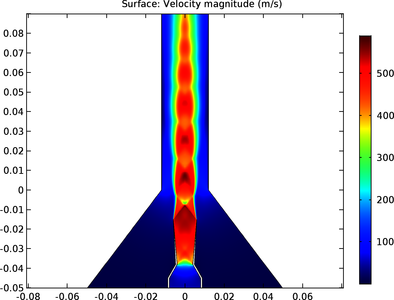
In this study, the compressible turbulent flow through a supersonic ejector is modeled using the High Mach Number Flow interface in the CFD Module. Ejectors are simple mechanical components used for a wide range of applications, including industrial refrigeration, vacuum generation, gas ... Read More
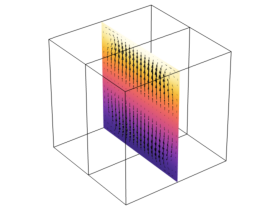
This example studies the stationary state of free convection in a cavity filled with water and bounded by two vertical plates. To generate the buoyancy flow, the plates are heated at different temperatures, bringing the regime close to the transition between laminar and turbulent. To ... Read More

This application presents an example of pressure driven flow and electrophoresis in a 3D micro channel system. Researchers often use a device similar to the one in this model as an electrokinetic sample injector in biochips to obtain well-defined sample volumes of dissociated acids and ... Read More
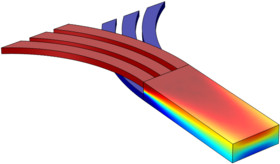
At the macroscopic level, systems usually mix fluids using mechanical actuators or turbulent 3D flow. At the microscale level, however, neither of these approaches is practical or even possible. This model demonstrates the mixing of fluids using laminar-layered flow in a MEMS mixer. This ... Read More
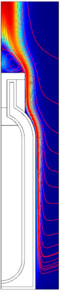
The following example solves a pure conduction and a free-convection problem in which a vacuum flask holding hot coffee dissipates thermal energy. The main interest is to calculate the flask's cooling power; that is, how much heat it loses per unit time. This tutorial model treats the ... Read More
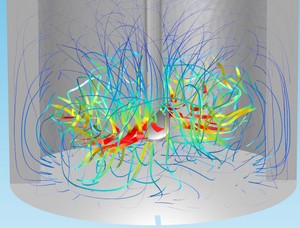
This model exemplifies the use of the Rotating Machinery interface, which allows you to model moving rotating parts in, for example, stirred tanks, mixers, and pumps. The Rotating Machinery interface formulates the Navier-Stokes equations in a rotating coordinate system. Parts that are ... Read More
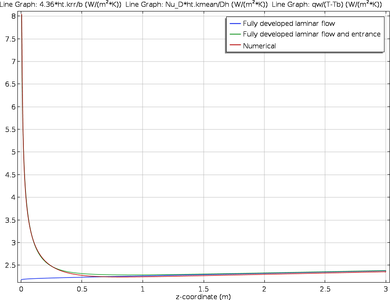
This verification model of nonisothermal laminar flow through a circular tube compares the heat transfer coefficient obtained from simulation with theoretical values based on Nusselt number correlation functions that can be found in the literature. Read More
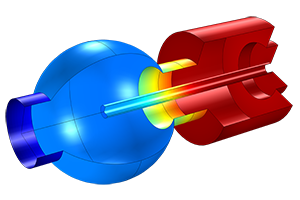
This model shows how to simulate the time-dependent adsorption and desorption of water in a vacuum system at low pressures. The water is introduced into the system when a gate valve to a load lock is opened and the subsequent migration and pumping of the water is modeled. Read More

In this model the high speed turbulent gas flow in a converging and diverging nozzle is modeled using the High Mach Number Flow interface. The diffuser is transonic in the sense that the flow at the inlet is subsonic, but due to the contraction and the low outlet pressure, the flow ... Read More