
The Application Gallery features COMSOL Multiphysics® tutorial and demo app files pertinent to the electrical, structural, acoustics, fluid, heat, and chemical disciplines. You can use these examples as a starting point for your own simulation work by downloading the tutorial model or demo app file and its accompanying instructions.
Search for tutorials and apps relevant to your area of expertise via the Quick Search feature. Note that many of the examples featured here can also be accessed via the Application Libraries that are built into the COMSOL Multiphysics® software and available from the File menu.
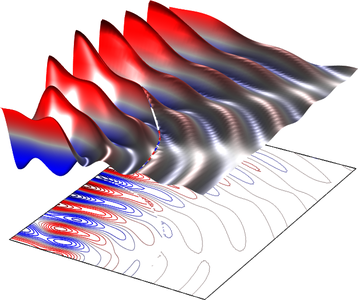
An axisymmetric model of a rigid piston in an infinite baffle is used to exemplify the Exterior Field Calculation feature of the Acoustics Module. The radiation results provided by the COMSOL Multiphysics® software are compared to analytical results for the on-axis radiation ... Read More
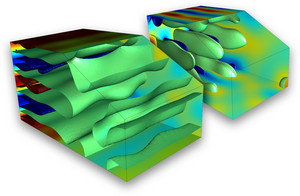
Sound is generated by a point source located in the wall of this test bench car interior. The sound pressure level response at a point of measurement is investigated for a range of frequencies and four different mesh resolutions. The model is first solved with the default direct solvers. ... Read More
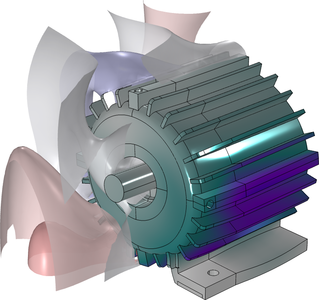
This model analyses the noise generated by an electric motor during its operation at different speeds of rotation. The type of electric motor analyzed, a permanent magnet synchronous motor (PMSM) uses permanent magnets in the rotor and a variable frequency current traveling through the ... Read More
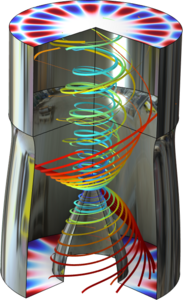
The acoustic field in a model of an axially symmetric lined aero-engine duct, based on modal sound transmission, is analyzed. The source is generated by a single mode excitation at a boundary. Sources and nonreflecting conditions are applied using port boundary conditions. The model ... Read More
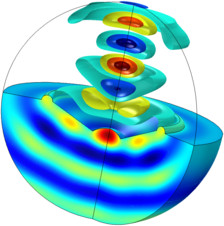
Example of a moving-coil loudspeaker where lumped parameters represent the behavior of the electrical and mechanical components. The Thiele-Small parameters (small-signal parameters) serve as input to the lumped model, which is represented using the Electric Circuit interface. The ... Read More
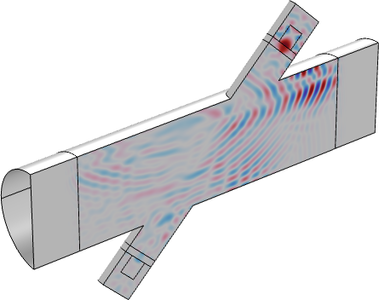
Ultrasonic flowmeters determine the velocity of a fluid flowing through a pipe by sending an ultrasonic signal across the flow at a skew angle. When there is no flow, the transmitting time between the transmitter and the receiver is the same for the signals sent in the upstream and ... Read More
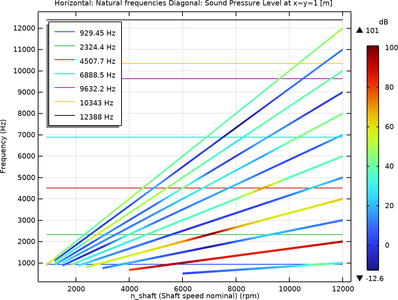
The noise emitted from an electrical machine can have many sources. In this example, acoustic noise from vibrations created by magnetic force variation is studied. Such noise is often audible at twice the excitation frequency but can also occur at higher frequencies or harmonics of the ... Read More
This is a model of a moving-coil loudspeaker where a lumped parameter analogy represents the behavior of the electrical and mechanical speaker components. The Thiele-Small parameters (small-signal parameters) serve as input to the lumped model, which is represented by an Electric Circuit ... Read More
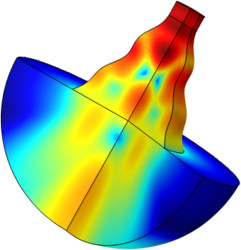
A plane-wave mode feeds an axisymmetric horn radiating from an infinite baffle toward an open half space. The radius of the waveguide attached to the horn throat is assumed to be fixed, as well as the depth of the horn and the size of the horn mouth attached to the baffle. By varying the ... Read More
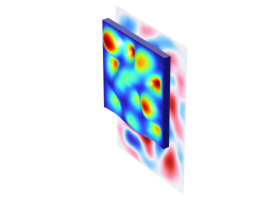
This model presents a practical and efficient method to compute the sound transmission loss (STL) through a building component, specifically this example treats the case of a concrete wall. The method used here is valid as long as the component has little influence on the acoustic field ... Read More