
The Application Gallery features COMSOL Multiphysics® tutorial and demo app files pertinent to the electrical, structural, acoustics, fluid, heat, and chemical disciplines. You can use these examples as a starting point for your own simulation work by downloading the tutorial model or demo app file and its accompanying instructions.
Search for tutorials and apps relevant to your area of expertise via the Quick Search feature. Note that many of the examples featured here can also be accessed via the Application Libraries that are built into the COMSOL Multiphysics® software and available from the File menu.
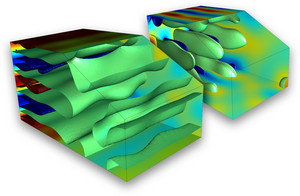
Sound is generated by a point source located in the wall of this test bench car interior. The sound pressure level response at a point of measurement is investigated for a range of frequencies and four different mesh resolutions. The model is first solved with the default direct solvers. ... Read More
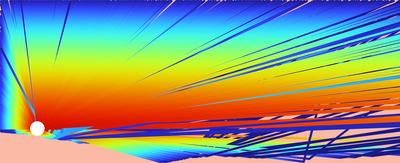
This example model simulates the long-path echo of trumpet sounds reflected from a building 500 m away. The echo can only be heard at night because of the acoustic ray refraction in the atmosphere with different temperature profiles. The model is solved using the ray tracing in the ... Read More
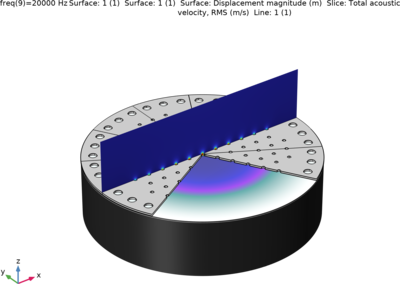
This is a model of a MEMS microphone solved in the frequency domain including the DC prestress effects. The model is set up using the Electromechanics multiphysics interface, Thermoviscous Acoustics, and Pressure Acoustics. The microphone consists of a perforated plate and a prestressed ... Read More
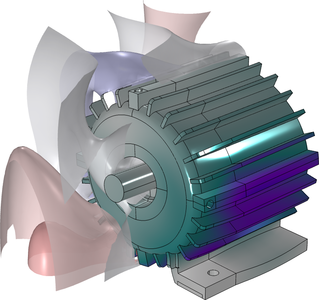
This model analyses the noise generated by an electric motor during its operation at different speeds of rotation. The type of electric motor analyzed, a permanent magnet synchronous motor (PMSM) uses permanent magnets in the rotor and a variable frequency current traveling through the ... Read More
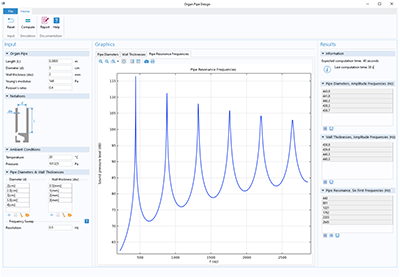
This app demonstrates the following: Using a Java® utility class for combining several waveforms and for playing sound Using tables for presenting results The app allows you to study the design of an organ pipe and then play the sound and pitch of the changed design. The pipe sound ... Read More
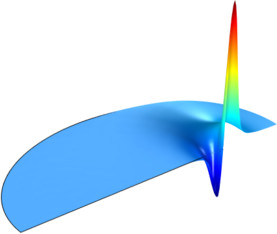
An ellipse with sound-hard walls has the interesting property that an acoustic signal emanating from one of the foci refocuses at the other focal point b/c seconds later, where b (in meters) is the major axis length and c (m/s) is the speed of sound. This model involves a Gaussian ... Read More

This model simulates a simple three-dimensional axisymmetric Helmholtz resonator, a classic acoustics model of a resonating circuit with a known theoretical solution. The idealized version considered here consists of a tube and a closed volume in series which are exposed to a pulsatile ... Read More
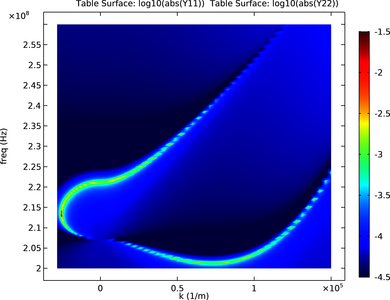
This model shows how to create dispersion diagrams from simulation results by extending the tutorial Thin-Film BAW Composite Resonator. The dispersion curve can be plotted against both real and imaginary values of the wave number, corresponding to the propagating modes and evanescent ... Read More
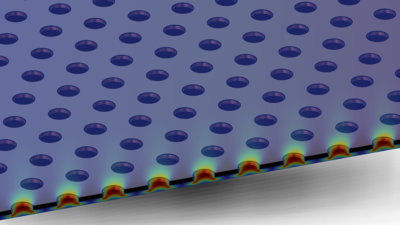
This tutorial model is of a micro perforated plate (also known as MPP) backed by a vibrating structure. This is a typical configuration in, for example, a MEMS microphone. The vibrating structure is not modeled explicitly, but just assigned a vibration velocity. The vibrating structure ... Read More
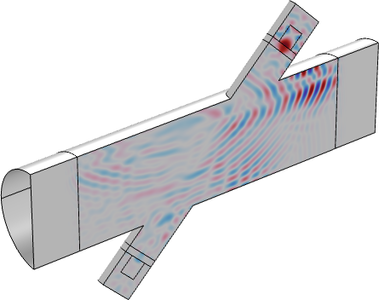
Ultrasonic flowmeters determine the velocity of a fluid flowing through a pipe by sending an ultrasonic signal across the flow at a skew angle. When there is no flow, the transmitting time between the transmitter and the receiver is the same for the signals sent in the upstream and ... Read More