
The Application Gallery features COMSOL Multiphysics® tutorial and demo app files pertinent to the electrical, structural, acoustics, fluid, heat, and chemical disciplines. You can use these examples as a starting point for your own simulation work by downloading the tutorial model or demo app file and its accompanying instructions.
Search for tutorials and apps relevant to your area of expertise via the Quick Search feature. Note that many of the examples featured here can also be accessed via the Application Libraries that are built into the COMSOL Multiphysics® software and available from the File menu.
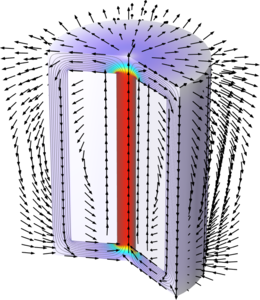
Magnetostrictive transduction is used in sonars, acoustic devices, active vibration, and position control and fuel injection systems. The transducer has a steel housing enclosing a drive coil. A magnetostrictive material is placed in the core, which works as an actuator when a magnetic ... Read More
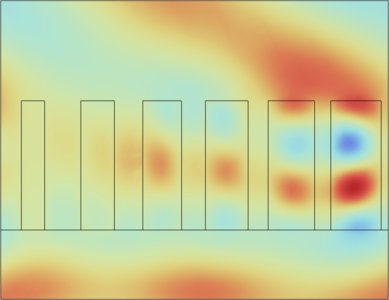
This model demonstrates how to simulate a metasurface beam deflector that uses anomalous refraction. The structure itself is a repeated array of six posts (so-called meta elements). The periodicity of the individual posts is 500 nm, so the full structure of six posts is 3 um wide. The ... Read More
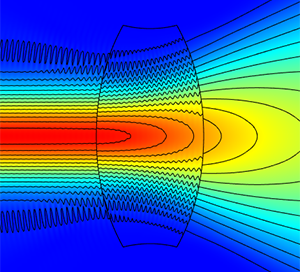
In this example, the properties of an engineeredmaterial are modeled by a spatially varying dielectric distribution. Specifically, a convex lens shape is defined via a known deformation of a rectangular domain. The dielectric distribution is defined on the undeformed, original ... Read More
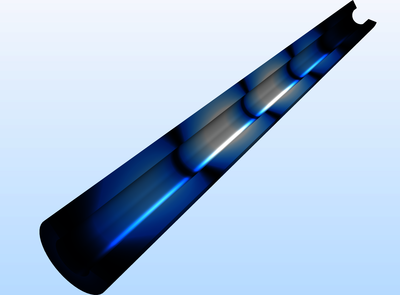
Simulation of Maxwell’s equations in the time domain is useful if the objective of the analysis is to observe a transient phenomenon, to find the time it takes a signal to propagate, or if the materials being modeled are non-linear with respect to the electric or magnetic field strength. ... Read More
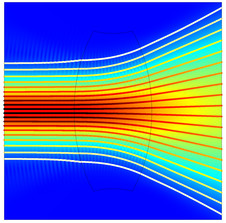
This example demonstrates how to set up a spatially varying dielectric distribution. Here, a convex lens shape is defined via a known deformation of a rectangular domain. The dielectric distribution is defined on the undeformed, original rectangular domain and is mapped onto the deformed ... Read More
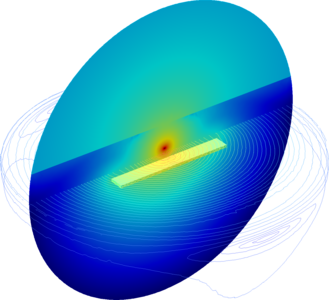
The marine controlled source electromagnetics method (CSEM) for oil prospecting has emerged as a promising technique during recent years. This model demonstrates one variant of it. It uses a mobile horizontal 1 Hz electric dipole antenna that is towed 150 m above the sea floor. An array ... Read More
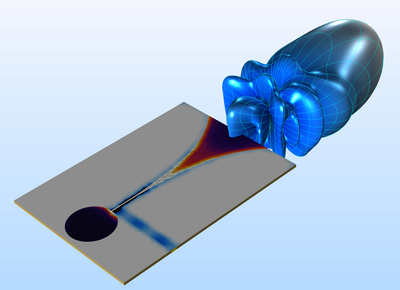
A tapered slot antenna, also known as a Vivaldi antenna, is useful for wide band applications. Here, an exponential function is used for the taper profile. The objective of this model is to compute the far-field pattern and to compute the impedance of the structure. Good matching is ... Read More

This model demonstrates how the Free Shape Boundary feature can be used to perform shape optimization on a design found with topology optimization. The model uses the same objective and constraint as the original, which results in a slightly higher stiffness for the same mass. Read More
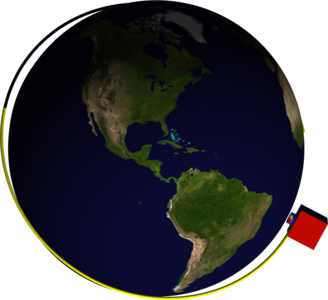
This model is an introduction to defining and verifying a satellite orbit, and computing the solar, albedo, and Earth infrared thermal loads. A 1U CubeSat is in a circular orbit at 400km altitude, inclination of 50°, and longitude of ascending node of 0°. The satellite is rotating slowly ... Read More
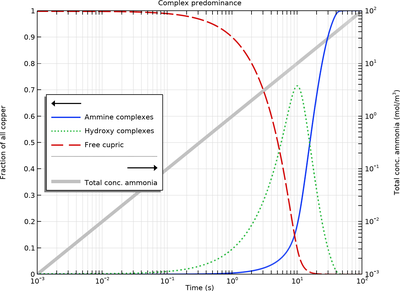
Cupric ions show a strong affinity to ammonia in aqueous solutions, forming strongly colored deep blue complexes. The relative amounts of the different ammine ligand complexes, with varying coordination numbers, are governed by the stability constants of the equilibria forming the ... Read More


