
The Application Gallery features COMSOL Multiphysics® tutorial and demo app files pertinent to the electrical, structural, acoustics, fluid, heat, and chemical disciplines. You can use these examples as a starting point for your own simulation work by downloading the tutorial model or demo app file and its accompanying instructions.
Search for tutorials and apps relevant to your area of expertise via the Quick Search feature. Note that many of the examples featured here can also be accessed via the Application Libraries that are built into the COMSOL Multiphysics® software and available from the File menu.
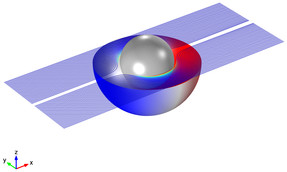
This model demonstrates the use of optical tracing for studying optically large gradient-index structures with anisotropic optical properties. Additionally, the model introduces a smoothing technique for handling discontinuities of refractive index on curved surfaces, which are typical ... Read More
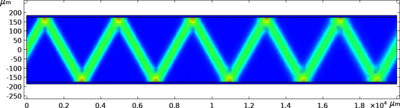
The bidirectional formulation of the Beam Envelopes interface can be used not only for counter-propagating wave simulations but also for waves propagating to up to two directions. In this model, an almost collimated Gaussian beam is excited at the left boundary and exhibits total ... Read More

Échelle spectrographs are commonly used in astronomy for high-resolution analyses of stellar atmospheres and for precision Doppler velocimetry. This tutorial simulates a "white pupil" form of this instrument. It makes use of several parts from the COMSOL Part Library and demonstrates the ... Read More
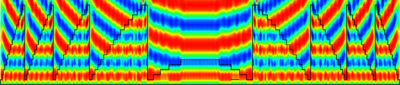
This model simulates a 16-level, first-order, focusing Fresnel lens with 50 µm diameter and 150 µm focal length. In one simulation, the Electromagnetic Waves, Frequency Domain interface computes the electric field in the Fresnel lens and the surrounding air domain extended to the focal ... Read More

The first part of the application computes the modes for a straight step index fiber made of silica glass. In the second part, a step index fiber bend with a 3 mm radius of curvature is analyzed with respect to propagating modes and radiation loss. It is shown how to find the power ... Read More
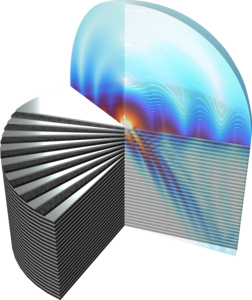
The modal dispersion in a metamaterial can be engineered by changing the type of material and dimension of the composing unit cells. For instance, a periodically organized subwavelength metal–dielectric layered metamaterial exhibits an anisotropic dispersion characteristic in the ... Read More
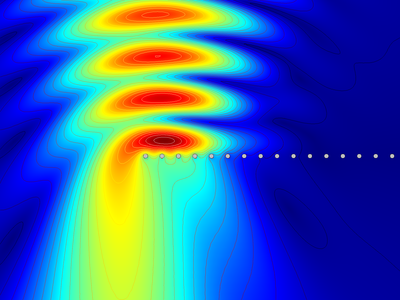
A Gaussian electromagnetic wave is incident on a dense array of very thin wires (or rods). The distance between the rods and, thus, the rod diameter is much smaller than the wavelength. Under these circumstances, the rod array does not function as a diffraction grating (see the Plasmonic ... Read More

This model simulates a beam of light being split into components of different frequencies when passing through a medium where the refractive index depends on frequency. COMSOL-wise, the model showcases two important technical aspects: A user-defined implementation of the frequency ... Read More

A plane TE-polarized electromagnetic wave is incident on a gold nanoparticle on a dielectric substrate. The absorption and scattering cross-sections of the particle are computed for a few different polar and azimuthal angles of incidence. The model first computes a background field from ... Read More
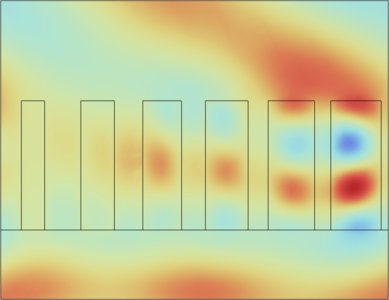
This model demonstrates how to simulate a metasurface beam deflector that uses anomalous refraction. The structure itself is a repeated array of six posts (so-called meta elements). The periodicity of the individual posts is 500 nm, so the full structure of six posts is 3 um wide. The ... Read More


