
The Application Gallery features COMSOL Multiphysics® tutorial and demo app files pertinent to the electrical, structural, acoustics, fluid, heat, and chemical disciplines. You can use these examples as a starting point for your own simulation work by downloading the tutorial model or demo app file and its accompanying instructions.
Search for tutorials and apps relevant to your area of expertise via the Quick Search feature. Note that many of the examples featured here can also be accessed via the Application Libraries that are built into the COMSOL Multiphysics® software and available from the File menu.

This is a conceptual model illustrating how to couple fluid-structure interaction, heat transfer, and thermal expansion. A bimetallic strip in an air channel is heated so that it bends. After some time, an airflow with an inlet temperature which varies in time is introduced. As a ... Read More
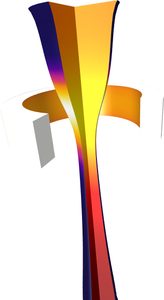
This example is about the modeling of the fiber drawing process. Thermal fiber drawing is a process in which a comparatively thicker structure is heated and drawn into extended lengths of microstructured fiber. This process is done by passing them through the furnace and pulling them ... Read More
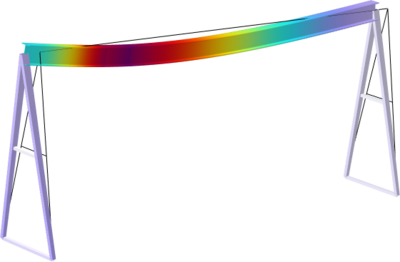
Portal Cranes are common when handling heavy loads. In this example, the Beam interface is used to compute the stresses in a portal crane designed for lifting 15 tons. Three load cases are considered: self weight, payload, and thermal expansion on a hot summer day. An internal hinge ... Read More
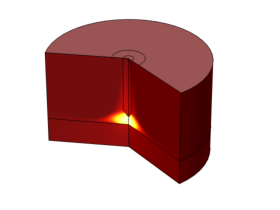
This example investigates the electrical and thermal characteristics of a plasma DC arc created in a point-to-plane configuration. The discharge is assumed to be in local thermodynamic equilibrium. The plasma is considered a conductive fluid medium and is modeled using a ... Read More
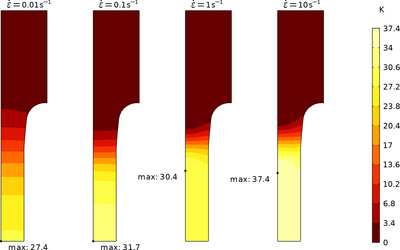
In this example, a tensile test is simulated at four different strain rates. The Johnson–Cook hardening law is used to model the strain rate dependency of the plastic hardening. The temperature distribution and thermal expansion caused by the heating generated by the plastic ... Read More
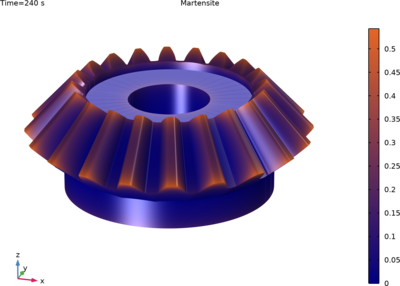
A 3D model is used to simulate the cooling of a bevel gear from an austenitic state. Phase material properties and phase transformation data are imported into the model. The final phase composition and the residual stress state are computed. Phenomena such as thermal strains, phase ... Read More
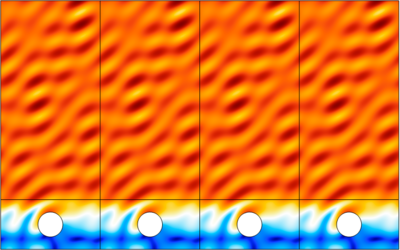
This is a model of acoustic absorption by a porous acoustic open cell foam. In porous materials the sound propagates in a network of small interconnected pores. Because the dimensions of the pores are small, losses occur due to thermal conduction and viscous friction. Acoustic foams are ... Read More
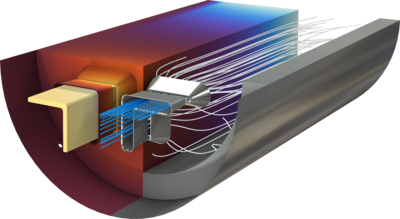
In massive forming processes like rolling or extrusion, metal alloys are deformed in a hot solid state with material flowing under ideally plastic conditions. Such processes can be simulated effectively using computational fluid dynamics, where the material is considered as a fluid with ... Read More
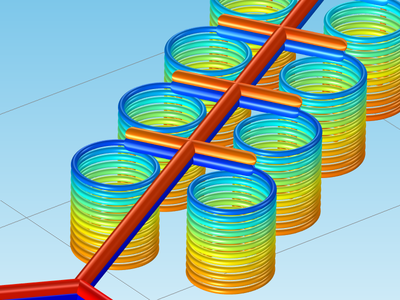
Ponds and lakes can serve as thermal reservoirs in geothermal heating applications. In this example, fluid circulates underwater through polyethylene piping in a closed system. The pipes are coiled in a slinky shape and grouped onto sleds. The Non-isothermal Pipe Flow interface sets up ... Read More
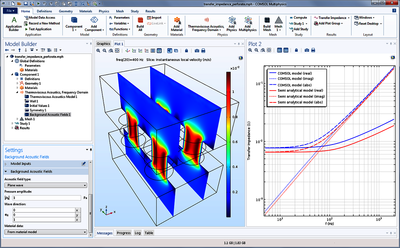
Perforates are plates with a distribution of small perforations or holes. They are used in muffler systems, sound absorbing panels, and in many other places as liners, where it is important to control attenuation precisely. As the perforations become smaller and smaller, viscous and ... Read More