
The Application Gallery features COMSOL Multiphysics® tutorial and demo app files pertinent to the electrical, structural, acoustics, fluid, heat, and chemical disciplines. You can use these examples as a starting point for your own simulation work by downloading the tutorial model or demo app file and its accompanying instructions.
Search for tutorials and apps relevant to your area of expertise via the Quick Search feature. Note that many of the examples featured here can also be accessed via the Application Libraries that are built into the COMSOL Multiphysics® software and available from the File menu.
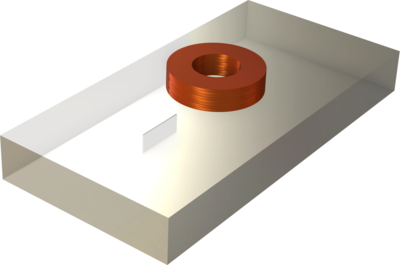
This model is a benchmark problem from TEAM workshop (problem 15 part I, see https://www.compumag.org/wp/team/). The model simulates the behavior of a coil as it scans a conductive plate containing a defect (a crack). The computed coil parameters, which include change in resistance and ... Read More
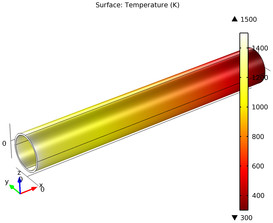
The heat distribution in a hollow pipe, whose ends are held at two different temperatures, is studied. The outside surface is assumed to be thermally isolated and the inner surfaces have radiation boundary conditions. The role of convection in the heat transfer is taken to be ... Read More
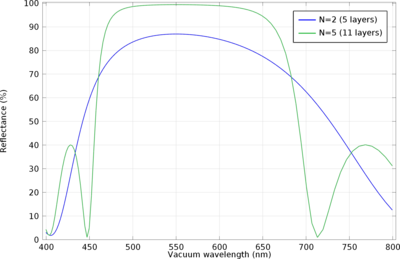
A distributed Bragg reflector (DBR) is a periodic structure formed from alternating dielectric layers that can be used to achieve nearly total reflection within a range of frequencies, with minimal losses. In this tutorial a Bragg reflector is modeled with a central wavelength of 550[nm] ... Read More
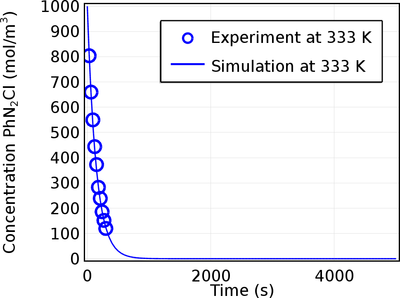
This example shows how to use the Parameter Estimation and Experiment features in the Reaction Engineering interface for optimization with multiple experimental data input files. The application finds the Arrhenius parameters of a first order reaction where Benzene diazonium chloride ... Read More
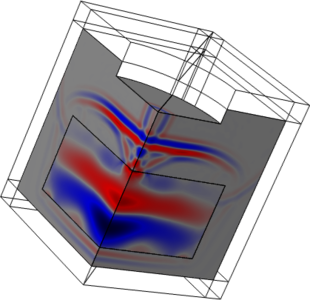
This tutorial showcases the principles of the immersion ultrasonic testing technique. A search unit placed in a water tank sends an ultrasonic pulse signal that scatters off a solid object. Part of the signal is reflected back to the search unit by the object and possible flaws in it. By ... Read More
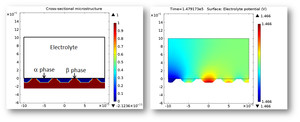
Galvanic corrosion between two different phases (alpha and beta phases) in a metallic (magnesium) alloy is simulated for a representative cross-sectional microstructure configuration. A key feature in the model formulation is the implementation of both anodic and cathodic regions at ... Read More
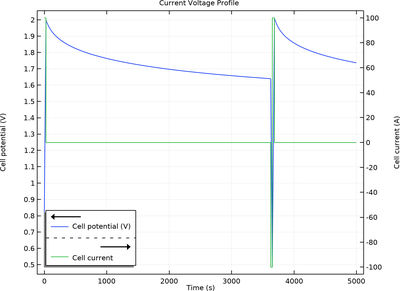
This model illustrates the effect of oxygen and hydrogen formation and recombination on the performance and self-discharge of an electrochemical capacitor with a water-based electrolyte. A load cycle consisting of mixed constant current pulses and rest periods at an open circuit is ... Read More
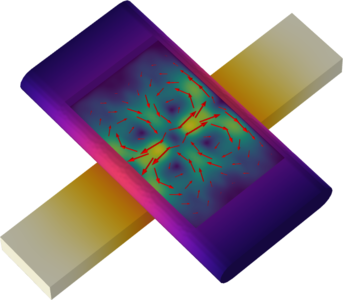
A 3D model of an acoustic trap in a glass capillary actuated by a piezoelectric transducer. The system is actuated by an oscillating electric potential across the piezoelectric transducer inducing mechanical vibrations in the solid and an acoustic pressure field in the fluid. The heat ... Read More
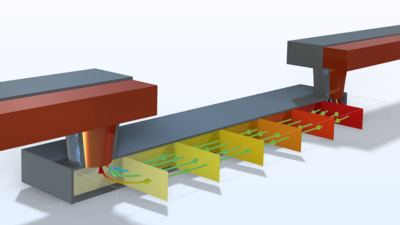
As integrated circuit (IC) technology advances, with circuits becoming more powerful and compact, it is increasingly important to identify and prevent any cause of circuit failure. One particularly critical factor contributing to circuit failure is electromigration within the ... Read More
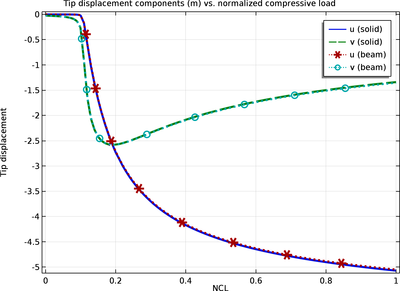
This example studies the deflection of a cantilever beam undergoing very large deflections. The beam is modeled using the Solid Mechanics, Shell, and Beam interfaces. The results are compared with each other and with a benchmark solution from NAFEMS. In addition, a linear buckling ... Read More


