
The Application Gallery features COMSOL Multiphysics® tutorial and demo app files pertinent to the electrical, structural, acoustics, fluid, heat, and chemical disciplines. You can use these examples as a starting point for your own simulation work by downloading the tutorial model or demo app file and its accompanying instructions.
Search for tutorials and apps relevant to your area of expertise via the Quick Search feature. Note that many of the examples featured here can also be accessed via the Application Libraries that are built into the COMSOL Multiphysics® software and available from the File menu.
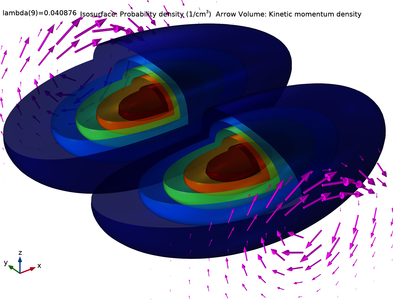
This tutorial model solves a two-component Schrödinger equation for the eigenstates of a simple silicon quantum dot in a uniform magnetic field, based on the paper by Jock et al. on the topic of spin-orbit qubits. The built-in domain condition Lorentz Force for the Schrödinger Equation ... Read More
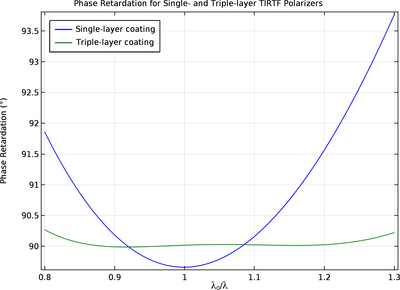
The capability to alter the polarization of light is crucial to a wide variety of optical devices. For example, the polarization of light has a significant effect on the performance of optical isolators, attenuators, and beam splitters. By assigning a specific polarization to light, most ... Read More
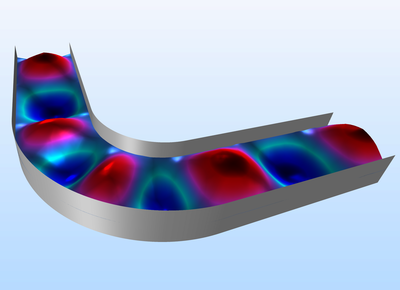
These examples show how to model a rectangular waveguide for microwaves in 2D and 3D. A single hollow waveguide can conduct two kinds of electromagnetic waves: transversal magnetic (TM) or transversal electric (TE) waves. The models examine a TE wave that has no electric field ... Read More

Some conventional three-port power dividers are resistive power dividers and T-junction power dividers. Such dividers are either lossy or not matched to the system reference impedance at all ports. In addition, isolation between two coupled ports is not guaranteed. The Wilkinson power ... Read More
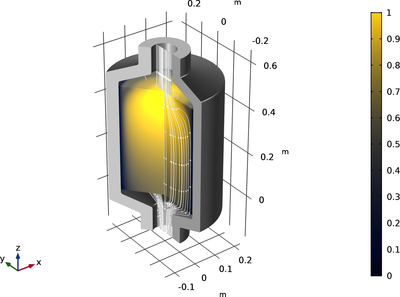
Thermal energy storage units are used to accumulate thermal energy from solar, geothermal, or waste heat sources. The simplest units are built from water tanks, often found in households, where the solar energy is stored as sensible heat. The thermal capacity of these tanks can be ... Read More
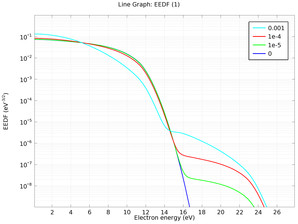
The electron energy distribution function (EEDF) plays an important role in the overall behavior of discharges. Analytic forms of the EEDF exist such as Maxwellian or Druyvesteyn, but in some cases they fail to fit the discharge physics. This tutorial model investigates the effects of ... Read More
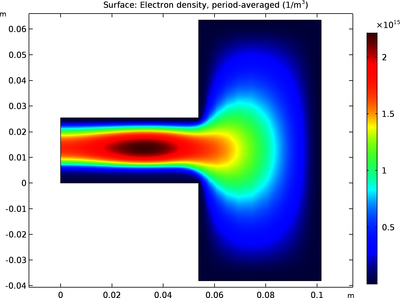
This model investigates the National Institute of Standards and Technology (NIST) Gaseous Electronics Conference (GEC) reference cell in two dimensions using the Plasma, Time Periodic interface. A 2D example helps in understanding the physics without excessive CPU time. The cell is ... Read More
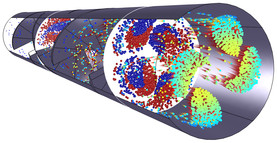
In static mixers, also called motionless or in-line mixers, a fluid is pumped through a pipe containing stationary blades. This mixing technique is particularly well suited for laminar flow mixing because it generates only small pressure losses in this flow regime. This example studies ... Read More
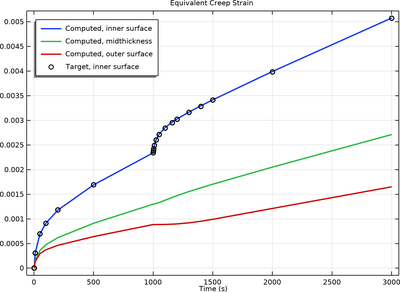
This model shows how to combine different types of material nonlinearity, such as creep and elastoplasticity. In this specific example you will perform a stress and nonlinear strain analysis on a thick cylinder under a nonproportional loading: an initial temperature increase followed by ... Read More

In this example, the dynamics of a hopping hoop is simulated. A rigid rolling ring with a point mass on the perimeter can, under certain conditions, jump up from the surface on which it is rolling. The effects of different parameters like initial velocity and friction are explored. You ... Read More


