
The Application Gallery features COMSOL Multiphysics® tutorial and demo app files pertinent to the electrical, structural, acoustics, fluid, heat, and chemical disciplines. You can use these examples as a starting point for your own simulation work by downloading the tutorial model or demo app file and its accompanying instructions.
Search for tutorials and apps relevant to your area of expertise via the Quick Search feature. Note that many of the examples featured here can also be accessed via the Application Libraries that are built into the COMSOL Multiphysics® software and available from the File menu.
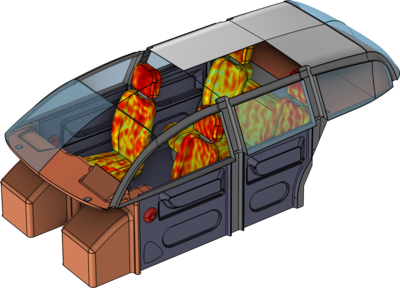
This tutorial shows the analysis of a car cabin in order to study the performance of a sound system in the low to mid frequency range. The cabin is of a typical sedan interior, that is, the inside of a hard-top family car. The model studies the frequency response at the location of a ... Read More
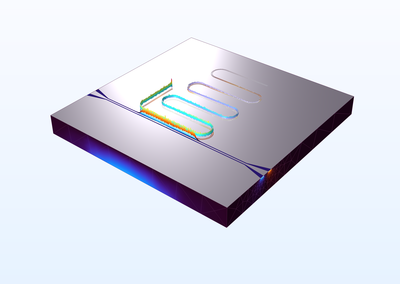
Developments in the last decade have made circuit quantum electrodynamics (cQED) the leading architecture for quantum computation. cQED is the solid-state version of cavity QED, which studies the basic light-matter interactions at the quantum level. This model examines one of the main ... Read More
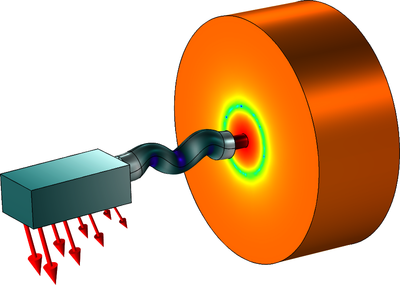
When simulations are involved in the development of mobile devices, consumer electronics, hearing aids, or headsets, it is necessary to consider how the transducers interact with the rest of the system. Here, we show an analysis of the interaction between a vibration isolation mounting ... Read More
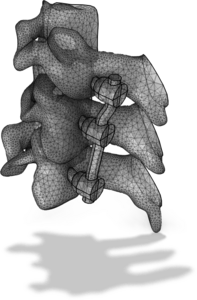
Follow this tutorial series to learn about how to work with imported surface meshes. The instructions detail how to import STL files of three vertebrae and two intervertebral discs as well as how to repair holes, misaligned mesh vertices, and intersecting elements. It further ... Read More
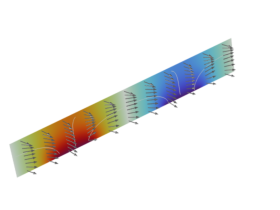
This model demonstrates the switching capability of a liquid crystal (LC) display cell in In-Plane Switching (IPS) configuration. The Oseen-Frank model is used to solve for the LC director (optical axis) distribution when a static electric field is applied. A Weak Form PDE interface is ... Read More
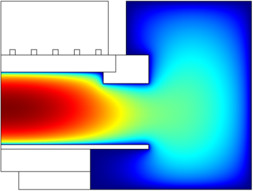
The GEC cell was introduced by NIST in order to provide a standardized platform for experimental and modeling studies of discharges in different laboratories. The plasma is sustained via inductive heating. The Reference Cell operates as an inductively-coupled plasma in this model. This ... Read More
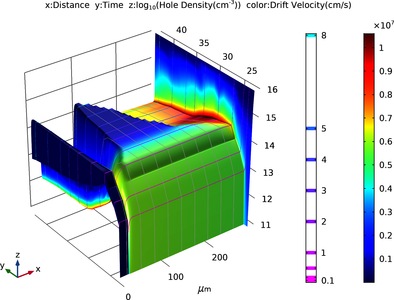
This tutorial performs steady-state and transient analysis of the response of a PIN diode to constant and pulsed radiation, respectively. The effect of radiation is modeled as spatially uniform generation of electron-hole pairs within the device. At high dose rates the separation of the ... Read More
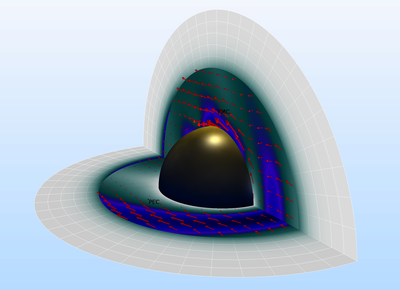
A classic benchmark problem in computational electromagnetics is to solve for the radar cross section (RCS) of a sphere in free space illuminated by a plane wave. This model solves for the RCS of a metallic sphere that has a very high conductivity, which can be treated as a material with ... Read More
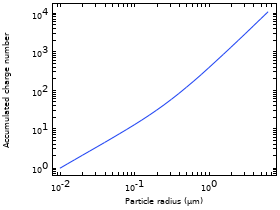
This model computes the fluid flow, charge transport and electric potential in an electrostatic precipitator. Based on the resulting fields, particles of different diameter are fed into the device and the transmission probability is computed. As expected, the separation efficiency shows ... Read More
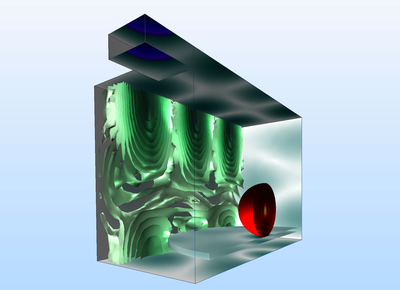
This is a model of the heating process in a microwave oven. The distributed heat source is computed in a stationary, frequency-domain electromagnetic analysis. This is followed by a transient heat transfer simulation showing how the heat redistributes in the food. Read More