
The Application Gallery features COMSOL Multiphysics® tutorial and demo app files pertinent to the electrical, structural, acoustics, fluid, heat, and chemical disciplines. You can use these examples as a starting point for your own simulation work by downloading the tutorial model or demo app file and its accompanying instructions.
Search for tutorials and apps relevant to your area of expertise via the Quick Search feature. Note that many of the examples featured here can also be accessed via the Application Libraries that are built into the COMSOL Multiphysics® software and available from the File menu.
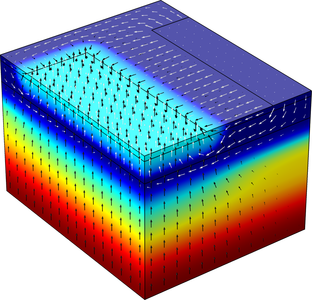
This model shows how to set up a 3D simulation of a n-p-n bipolar transistor. It is a 3D version of the device shown in the Bipolar Transistor model, and demonstrates how to extend semiconductor modeling into 3D using COMSOL Multiphysics. As in the 2D version of this model, the device ... Read More
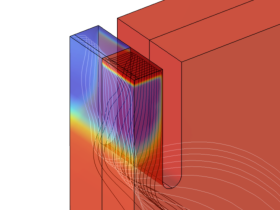
In this second half of a two-part example, a 3D model of a trench-gate IGBT is built by extruding the 2D model from the first half. Unlike the 2D model, now it is possible to arrange the alternating n+ and p+ emitters along the direction of extrusion as in the real device. This more ... Read More
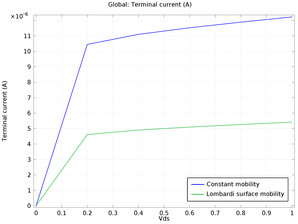
Surface acoustic phonons and surface roughness have an important effect on the carrier mobility, especially in the thin inversion layer under the gate in MOSFETs. The Lombardi surface mobility model adds surface scattering resulting from these effects to an existing mobility model using ... Read More
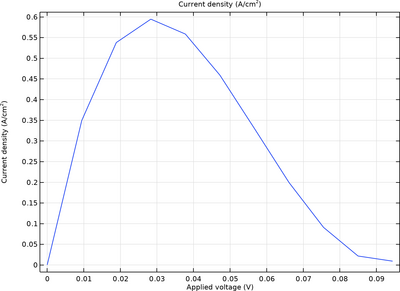
This tutorial demonstrates how to model the band-to-band tunneling across a p–n junction. The tunneling effect is imitated by defining the User-Defined Recombination domain feature which makes the electrons disappear from the conduction band on the n-side and holes disappear from the ... Read More
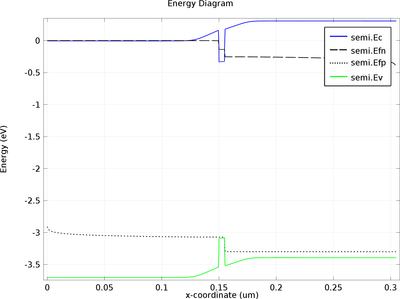
This model simulates a GaN based light emitting diode. The emission intensity, spectrum, and quantum efficiency are calculated as a function of the driving current. Direct radiative recombination across the band gap is modeled, as well as non-radiative Auger and trap-assisted ... Read More
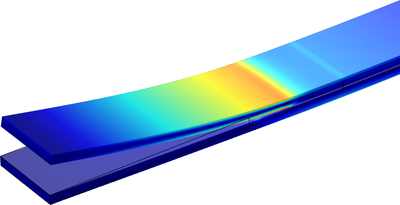
Interfacial failure by delamination or debonding can be simulated with a Cohesive Zone Model (CZM). This example shows the implementation of a CZM with a bilinear traction-separation law. It is used to predict the mixed-mode softening onset and delamination propagation in a composite ... Read More
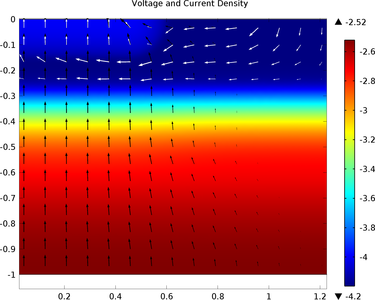
This model shows how to set up a simple Bipolar Transistor model. The output current-voltage characteristics in the common-emitter configuration are computed and the common-emitter current gain is determined. Read More
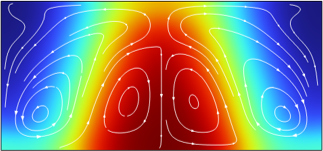
In acoustofluidics, acoustics is used to manipulate particles and fluids in microfluidic devices. This model demonstrates the phenomena of the inhomogeneous acoustic body force and how it can move a fluid with an inhomogeneous density due to a solute. The model is of a 2D cross section ... Read More
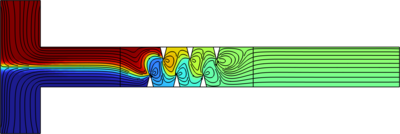
In microfluidic devices, it is a challenge to mix different fluids. One method is to use acoustic streaming to create a flow which enhances the mixing of two fluids. In this model, the vibrations of PDMS structures in a channel induces fast acoustic streaming used for mixing a diluted ... Read More
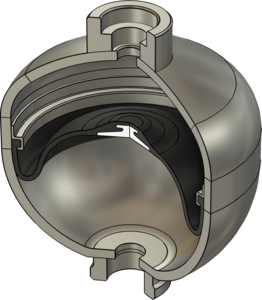
Diaphragm accumulators are essential components that store energy and regulate hydraulic systems. A flexible rubber diaphragm divides the hydraulic fluid from a compressible inert gas, typically nitrogen. These accumulators perform multiple tasks, such as temporarily storing hydraulic ... Read More