
The Application Gallery features COMSOL Multiphysics® tutorial and demo app files pertinent to the electrical, structural, acoustics, fluid, heat, and chemical disciplines. You can use these examples as a starting point for your own simulation work by downloading the tutorial model or demo app file and its accompanying instructions.
Search for tutorials and apps relevant to your area of expertise via the Quick Search feature. Note that many of the examples featured here can also be accessed via the Application Libraries that are built into the COMSOL Multiphysics® software and available from the File menu.
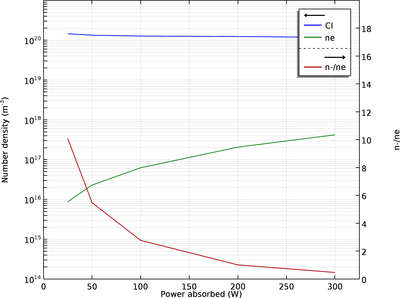
Plasma discharges containing chlorine are commonly used to etch semiconductors and metals in microelectronics fabrication. This tutorial model studies chlorine plasma discharges using a global (volume-averaged) diffusion model. Global diffusion models can run simulations in a fraction ... Read More

Chemical mechanical polishing (CMP) is a crucial technique for surface planarization, widely used in semiconductor fabrication and optical device manufacturing. This model approximates the flow field of the slurry using a turbulent single-phase flow model. The Frozen Rotor approach is ... Read More
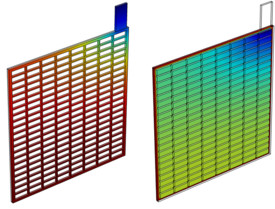
This 3D model example demonstrates the use of the Primary Current Distribution interface for modeling current distributions in electrochemical cells. In primary current distribution, the potential losses due to electrode kinetics and mass transport are assumed to be negligible, and ... Read More
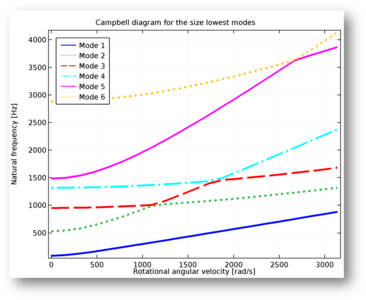
The eigenfrequencies of a rotating blade are studied in this benchmark. It shows how stress stiffening and spin softening affect the fundamental eigenfrequency. High rotational speeds in rotating machinery can result in centrifugal forces of considerable magnitude. The forces induced by ... Read More
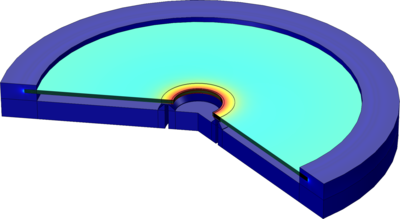
Piezoelectric valves are frequently employed in medical and laboratory applications due to their fast response times and quiet operation. Their energy efficient operation, also dissipates little heat, which is often important for these applications. This model shows how to model a ... Read More
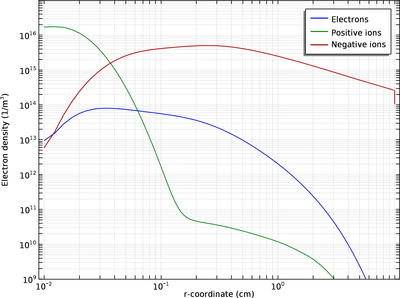
This tutorial model presents a study of a coaxial DC corona discharge in dry air at atmospheric pressure. The dimensions and operation conditions are similar to ones found in electrostatic precipitators with wire-to-plate configurations. The inner wire electrode has a 100-mm radius and ... Read More

A 2D model of a steel bar is used to simulate oil quenching from an austenitic state. Both diffusive and displacive phase transformations are used, and the phase composition is computed in the radial direction of the bar. Read More
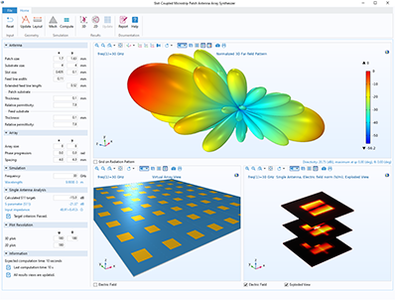
This app demonstrates the following: Parameterized geometries Visualizing material appearance, color, and texture Multiple plots in the same window to visualize the results Options to visualize the results with different views using check boxes Microstrip patch antenna arrays are ... Read More


