
The Application Gallery features COMSOL Multiphysics® tutorial and demo app files pertinent to the electrical, structural, acoustics, fluid, heat, and chemical disciplines. You can use these examples as a starting point for your own simulation work by downloading the tutorial model or demo app file and its accompanying instructions.
Search for tutorials and apps relevant to your area of expertise via the Quick Search feature. Note that many of the examples featured here can also be accessed via the Application Libraries that are built into the COMSOL Multiphysics® software and available from the File menu.
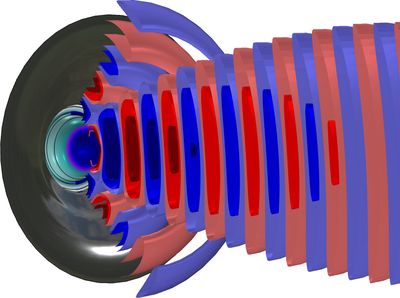
A tweeter is a high frequency driver used in loudspeaker systems. An ideal tweeter will produce a constant sound pressure level at a given distance in front of the driver independently of frequency, that is, a flat response. Ideally the tweeter will also, to a certain degree, maintain ... Read More
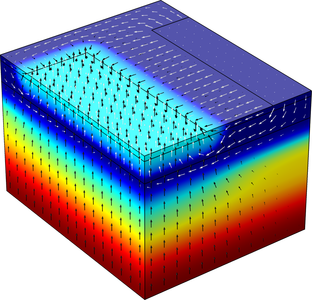
This model shows how to set up a 3D simulation of a n-p-n bipolar transistor. It is a 3D version of the device shown in the Bipolar Transistor model, and demonstrates how to extend semiconductor modeling into 3D using COMSOL Multiphysics. As in the 2D version of this model, the device ... Read More
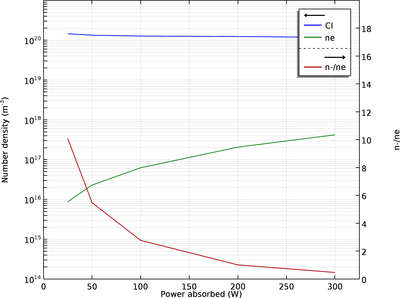
Plasma discharges containing chlorine are commonly used to etch semiconductors and metals in microelectronics fabrication. This tutorial model studies chlorine plasma discharges using a global (volume-averaged) diffusion model. Global diffusion models can run simulations in a fraction ... Read More

It is possible to shape the radiation pattern and steer the beam from an antenna array by controlling the relative phases and magnitudes of the input signal. This example shows how to design an active electronically scanned array (AESA) using arithmetic phase progression on each antenna ... Read More
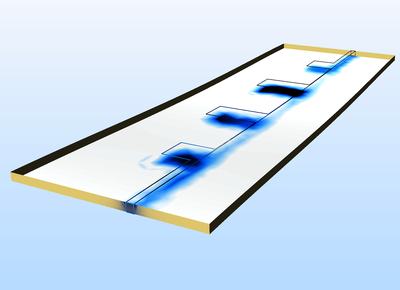
Microstrip filters can be fabricated directly on a printed circuit board (PCB) with a microstrip line going from the input to the output. Along the microstrip line there are a number of stubs of certain lengths and widths. The design of the filter involves choosing the impedance of the ... Read More
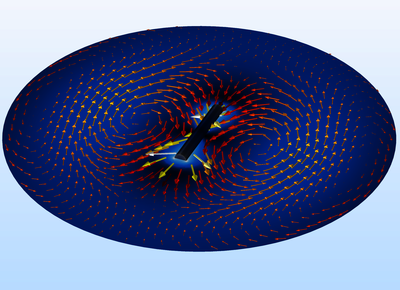
A metallic cylindrical rod is hidden inside a spherical dielectric shell and its orientation is unknown. By studying the polarization-dependent scattered field of a cylindrical object and performing a parametric sweep as a function of polarization angle, the rod is detected for the ... Read More
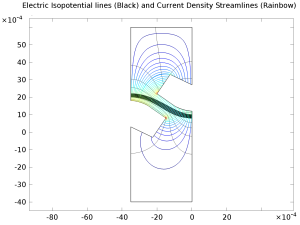
The chlor-alkali membrane process is one of the largest in industrial electrolysis with the production of roughly 40 million metric tons of both chlorine and caustic soda per year. Chlorine is used predominantly for the production of vinyl chloride monomer, which in turn is used for the ... Read More
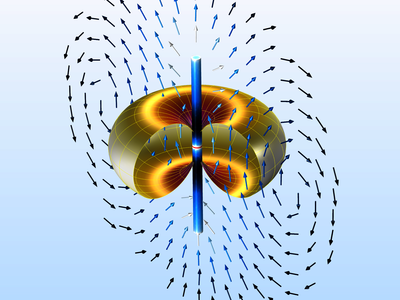
The dipole antenna is one of the most straightforward antenna configurations. It can be realized with two thin metallic rods that have a sinusoidal voltage difference applied between them. The length of the rods is chosen such that they are quarter wavelength elements at the operating ... Read More
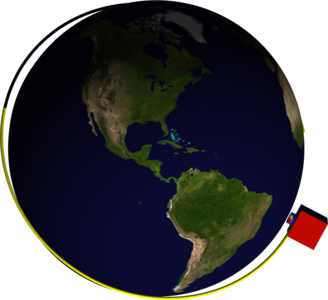
This model is an introduction to defining and verifying a satellite orbit, and computing the solar, albedo, and Earth infrared thermal loads. A 1U CubeSat is in a circular orbit at 400km altitude, inclination of 50°, and longitude of ascending node of 0°. The satellite is rotating slowly ... Read More
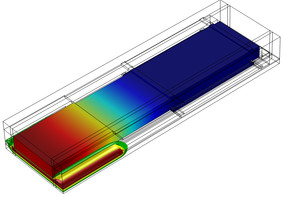
An electrostatically actuated MEMS resonator is simulated in the time and frequency domains. The device is driven by an AC + DC bias voltage applied across a parallel plate capacitor. The dependence of the resonant frequency on DC bias is assessed, and frequency domain and transient ... Read More


