
The Application Gallery features COMSOL Multiphysics® tutorial and demo app files pertinent to the electrical, structural, acoustics, fluid, heat, and chemical disciplines. You can use these examples as a starting point for your own simulation work by downloading the tutorial model or demo app file and its accompanying instructions.
Search for tutorials and apps relevant to your area of expertise via the Quick Search feature. Note that many of the examples featured here can also be accessed via the Application Libraries that are built into the COMSOL Multiphysics® software and available from the File menu.
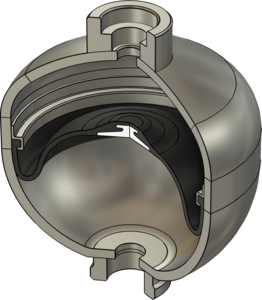
Diaphragm accumulators are essential components that store energy and regulate hydraulic systems. A flexible rubber diaphragm divides the hydraulic fluid from a compressible inert gas, typically nitrogen. These accumulators perform multiple tasks, such as temporarily storing hydraulic ... Read More
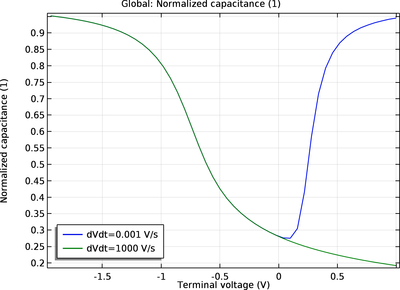
The metal-silicon-oxide (MOS) structure is the fundamental building block for many silicon planar devices. Its capacitance measurements provide a wealth of insight into the working principles of such devices. This tutorial constructs a simple 1D model of a MOS capacitor (MOSCAP). Both ... Read More
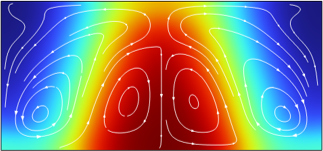
In acoustofluidics, acoustics is used to manipulate particles and fluids in microfluidic devices. This model demonstrates the phenomena of the inhomogeneous acoustic body force and how it can move a fluid with an inhomogeneous density due to a solute. The model is of a 2D cross section ... Read More
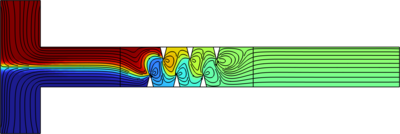
In microfluidic devices, it is a challenge to mix different fluids. One method is to use acoustic streaming to create a flow which enhances the mixing of two fluids. In this model, the vibrations of PDMS structures in a channel induces fast acoustic streaming used for mixing a diluted ... Read More
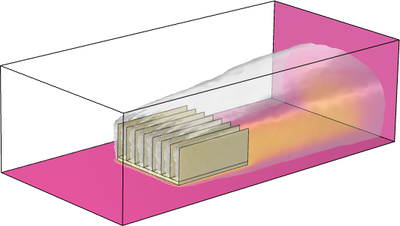
Thermoelectric elements are often used to cool or heat electronic components to a desired temperature. In such simulations, you are typically not interested in the behavior of the thermoelectric element itself but want to use its performance characteristics to model the overall response ... Read More
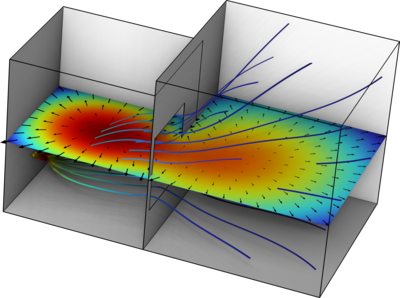
This verification model analyzes the acoustics of two coupled rooms using the Acoustic Diffusion Equation interface of the Acoustics Module. The results of the model agree with numerical results that are validated against measurements in a reference paper. Read More
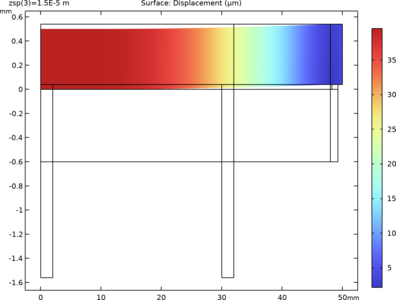
This models pressure-dependent heating of 4 inch wafer on unipolar electrostatic chuck. Wafer sits on top of ring with electrostatic force holdong down wafer to counter upward pressure from gas flowing in gap between wafer and chuck surface. It is a problem involving 4 coupled physics ... Read More
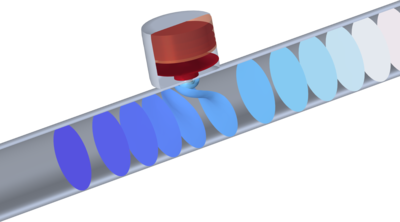
This tutorial model shows a system consisting of a Helmholtz resonator on the side of a main duct. The resonator volume is partly filled with a porous material. The model computes the reflection, transmission, and absorption of the system. Thermoviscous losses are included in the model ... Read More

Finding acoustic eigenmodes in problems solved with linearized convected acoustic interfaces can be a challenging task. The solution will most often return several non-acoustic vorticity and entropy modes. These are highly damped waves that do not propagate at the speed of sound but with ... Read More
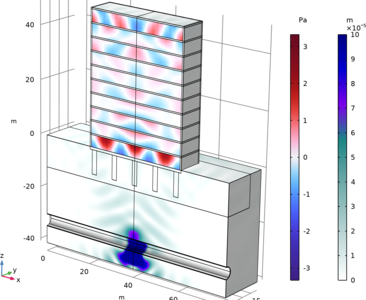
Underground train grids span large areas under London, Paris, New York, and other cities. The building regulations require strict noise standards, and failure to comply could result in significant losses in the market prices of developments. Therefore, train-induced noise has to be ... Read More