
The Application Gallery features COMSOL Multiphysics® tutorial and demo app files pertinent to the electrical, structural, acoustics, fluid, heat, and chemical disciplines. You can use these examples as a starting point for your own simulation work by downloading the tutorial model or demo app file and its accompanying instructions.
Search for tutorials and apps relevant to your area of expertise via the Quick Search feature. Note that many of the examples featured here can also be accessed via the Application Libraries that are built into the COMSOL Multiphysics® software and available from the File menu.
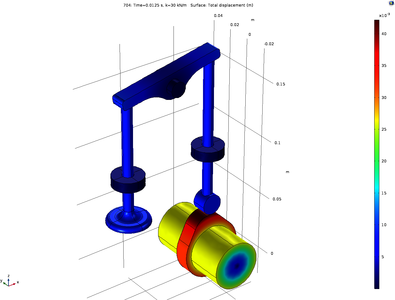
In this example, a spring-loaded valve-opening mechanism consisting of a rocker arm and a radial cam is studied. All of the system components are modeled as rigid and are connected through prismatic, hinge, and slot joints. The cam-follower connection as well as other joint connections ... Read More
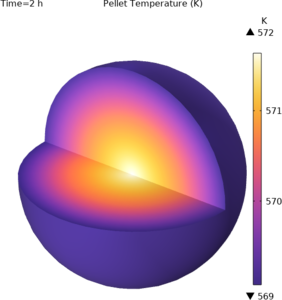
1D model of a thermal energy storage (TES) system consisting of a packed bed of pellets. Three approaches for heat transfer in porous media are compared: A one-equation local thermal equilibrium (LTE) model A two-equations local thermal nonequilibrium (LTNE) model A multiscale ... Read More
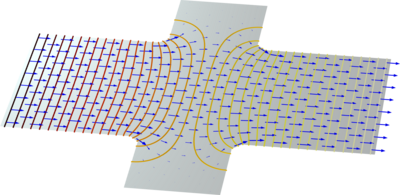
This example uses the Electric Currents in Layered Shells interface and the Layered Shell interface to model a piezoresistive pressure sensor. The tutorial considers the design of the MPX100 series pressure sensors originally manufactured by Motorola Inc. Although the sensor is no ... Read More
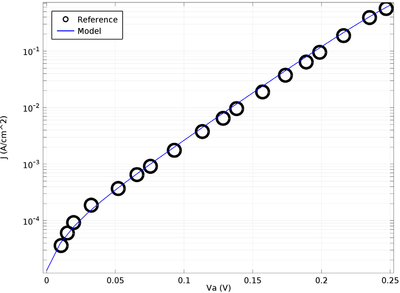
Schottky Contact This benchmark simulates the behavior of an ideal Schottky barrier diode made of a tungsten contact deposited on a silicon wafer. The resulting J-V (current density vs. applied voltage) curve obtained from the model under forward bias is compared with experimental ... Read More
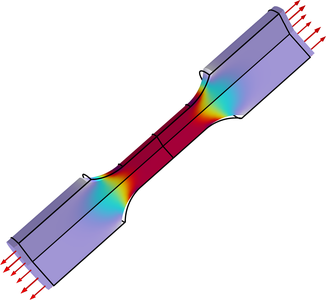
The model shows how to estimate the Young's modulus and Poisson ratio based on a tensile test. The test measures the tensile force and the radial displacement for different values of the prescribed displacement. The model is based on synthetic data generated in the model itself. It is ... Read More

This application demonstrates how you can access and include external thermodynamic and physical property calculations in your simulation, using the Thermodynamics feature. The example shows how you can easily modify the predefined Plug-flow reactor type in the Reaction Engineering ... Read More

This model demonstrates the transport of grains using a screw conveyor. The grains enter the conveyor through a chute and are transported over an incline by a rotating screw. This model also demonstrates how to build and run a model method that evaluates the mass flow rate. Read More
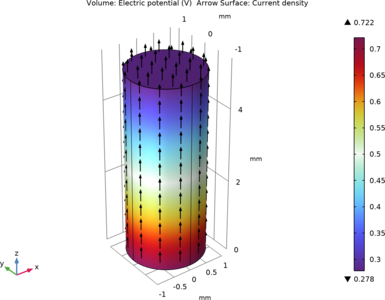
HowTo: Using the EC External I-Terminal The External Couplings in the CIR interface has two flavors that can be used. External I vs. U and External I-terminal. The former has two nodes (it represents a differential external voltage measurement) and when coupling to an EC Terminal ... Read More
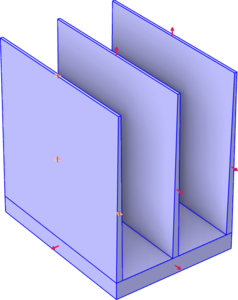
These tutorial models show how to use the tools to assist with defining surface-to-surface radiation models. In the first model, radiation direction symbols are used to find an unexpected configuration where the opacity is not correctly defined. In the other, the topology check ... Read More
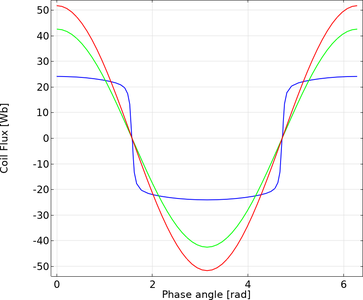
A model comparing the magnetization material models in time-dependent and frequency domain studies. Effective B-H curves are used for frequency domain. A linear relative permeability is included as reference. Read More


