
The Application Gallery features COMSOL Multiphysics® tutorial and demo app files pertinent to the electrical, structural, acoustics, fluid, heat, and chemical disciplines. You can use these examples as a starting point for your own simulation work by downloading the tutorial model or demo app file and its accompanying instructions.
Search for tutorials and apps relevant to your area of expertise via the Quick Search feature. Note that many of the examples featured here can also be accessed via the Application Libraries that are built into the COMSOL Multiphysics® software and available from the File menu.
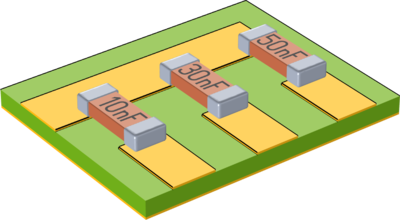
These models demonstrate the usage of the user defined lumped port and lumped elements to introduce excitations and lumped circuit elements between volumetric conductors. Additional models show how to use impedance and transition boundary conditions to model the conductors, instead of ... Read More
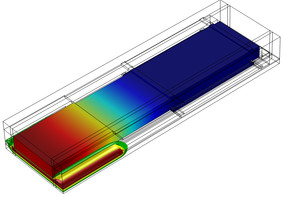
An electrostatically actuated MEMS resonator is simulated in the time and frequency domains. The device is driven by an AC + DC bias voltage applied across a parallel plate capacitor. The dependence of the resonant frequency on DC bias is assessed, and frequency domain and transient ... Read More
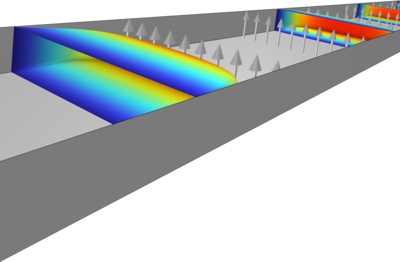
In nuclear fusion reactors, the conducting fluid, such as the fusion plasma and the liquid metal in the reactor blanket, will interact with the background magnetic field. This phenomenon is referred to as magnetohydrodynamics (MHD). The electromagnetic field and fluid flow are fully ... Read More

In small PEM fuel cell systems (in the sub-100 W range) no active devices for cooling or air transport are normally used. This is due to the desire to minimize parasitic power losses from pumps and fans, and to reduce the system complexity, size, and cost. The reactants at the cathode ... Read More
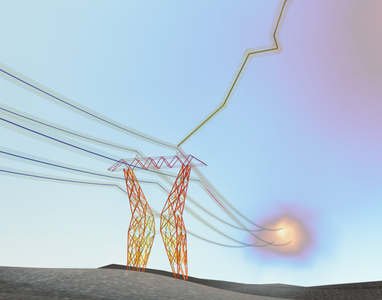
This model demonstrates the analysis of lightning surges on high voltage transmission line towers. Lightning carrying a current of 10 kA struck one of the tower's shielded wires. The induced voltage at the three-phase conductors are computed. Some highlights of this model: Perform ... Read More
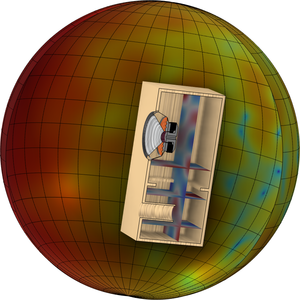
This tutorial models the acoustic behavior of a loudspeaker driver mounted in a bass reflex enclosure. The enclosure, sometimes called the cabinet, alters substantially the sensitivity and radiation characteristics of the loudspeaker and it is why it is usually considered part of the ... Read More
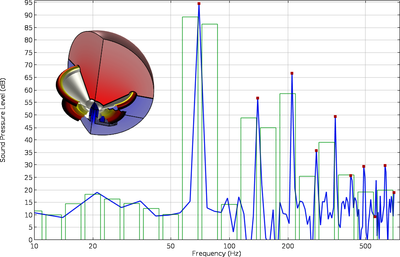
In this model, a full transient analysis of a loudspeaker driver is performed, which allow the modeling of nonlinear effects. It extends the linear frequency domain analysis done in the Loudspeaker Driver tutorial model. The analysis accounts for nonlinear behavior of the soft iron in ... Read More
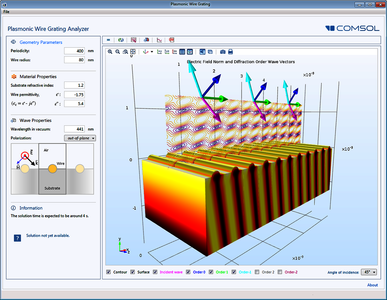
Surface plasmon-based circuits are being used in applications such as plasmonic chips, light generation, and nanolithography. The Plasmonic Wire Grating Analyzer application computes the coefficients of refraction, specular reflection, and first-order diffraction as functions of the ... Read More
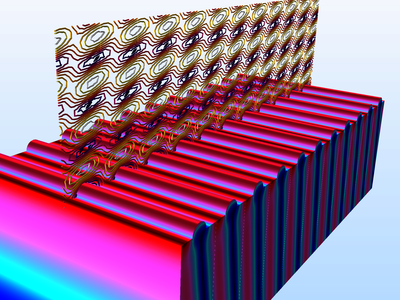
Surface plasmon-based circuits are being used in applications such as plasmonic chips, light generation, and nanolithography. The Plasmonic Wire Grating Analyzer application computes the coefficients of refraction, specular reflection, and first-order diffraction as functions of the ... Read More
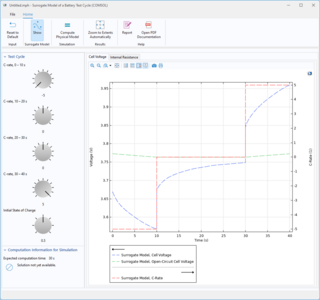
This app demonstrates the usage of a surrogate model function for predicting the cell voltage, cell open circuit voltage and internal resistance of an NMC111/graphite battery cell undergoing a battery test cycle. The surrogate function, a Deep Neural Network, has been fitted to a ... Read More