
The Application Gallery features COMSOL Multiphysics® tutorial and demo app files pertinent to the electrical, structural, acoustics, fluid, heat, and chemical disciplines. You can use these examples as a starting point for your own simulation work by downloading the tutorial model or demo app file and its accompanying instructions.
Search for tutorials and apps relevant to your area of expertise via the Quick Search feature. Note that many of the examples featured here can also be accessed via the Application Libraries that are built into the COMSOL Multiphysics® software and available from the File menu.
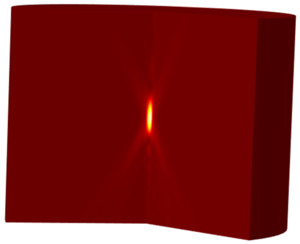
This tutorial shows how to model tissue heating induced by focused ultrasound. First, the stationary acoustic field in the water and the tissue are modeled to obtain the acoustic intensity distribution in the tissue. The absorbed acoustic energy is then calculated and used as the heat ... Read More
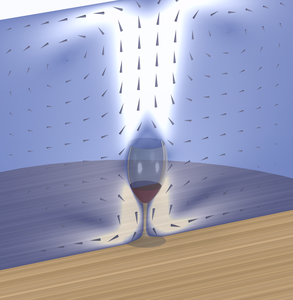
During professional wine tasting, several samples of wine are judged in one session. It is important that each sample is covered, since evaporation of ethanol and water will change the taste. This model simulates the evaporation of ethanol and water from a wine glass. Evaporation of ... Read More

This tutorial models the intercoupled electrochemical reactions, charge and species transport as well as heat transfer in a polymer electrolyte membrane (PEM) fuel cell. For the gas flow fields, straight channels are used on the hydrogen anode side, whereas a mesh structure is used on ... Read More
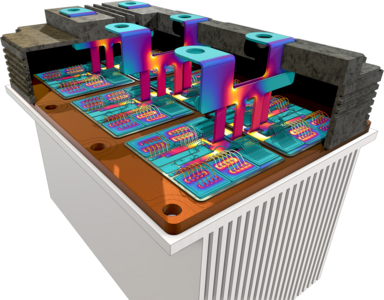
This industrial-scale proof of concept (POC) model demonstrates how to perform an electric-thermal analysis of a high-power insulated-gate bipolar transistor module (IGBT module). The module has a rated voltage of 1200 V, and nominal current of 1800 A. Using a stationary study the ... Read More
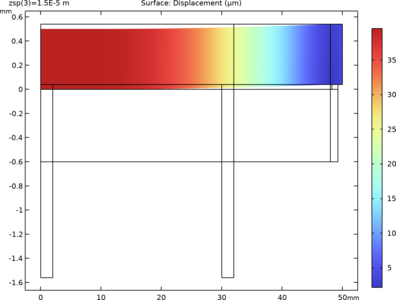
This models pressure-dependent heating of 4 inch wafer on unipolar electrostatic chuck. Wafer sits on top of ring with electrostatic force holdong down wafer to counter upward pressure from gas flowing in gap between wafer and chuck surface. It is a problem involving 4 coupled physics ... Read More
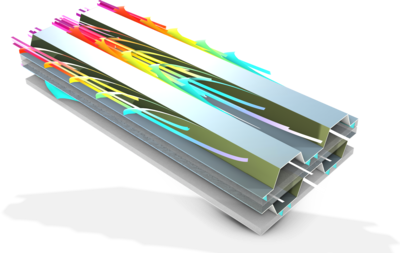
This model defines a zero-gap alkaline water electrolyzer, where oxygen and hydrogen gas are evolved in porous gas diffusion nickel felt electrodes, placed adjacent to a porous separator (diaphragm). The geometry defines a unit cell of an electrolyzer stack, in turn comprising two full ... Read More
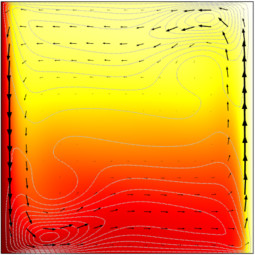
This model couples the Navier Stokes equations and the heat transfer equations to examine density driven flow of free fluids. Here the fluid is in a square cavity with a heated wall. The buoyancy force is a Boussinesq term added to the Navier-Stokes equations. The equation is ... Read More
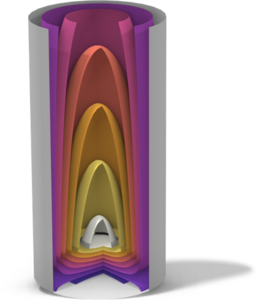
Inside of a combustion chamber, the gas mix behaves as a non-gray medium. Such media require a lot of data and computational resources to get results across the whole spectrum. The Weighted Sum of Gray Gases Model (WSGG) proposes an approach to model the non-gray gas mix as a sum of ... Read More
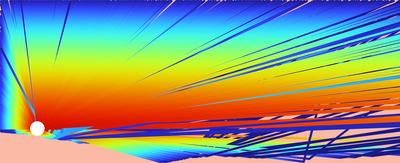
This example model simulates the long-path echo of trumpet sounds reflected from a building 500 m away. The echo can only be heard at night because of the acoustic ray refraction in the atmosphere with different temperature profiles. The model is solved using the ray tracing in the ... Read More
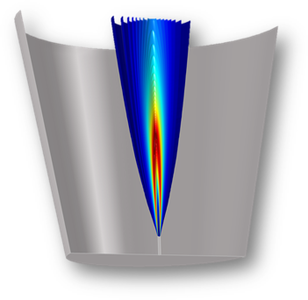
The model simulates non-premixed turbulent combustion of syngas (synthesis gas) in a simple round-jet burner. Syngas is a gas mixture, primarily composed of hydrogen, carbon monoxide and carbon dioxide. The name syngas relates to its use in creating synthetic natural gas. In the model, ... Read More