
The Application Gallery features COMSOL Multiphysics® tutorial and demo app files pertinent to the electrical, structural, acoustics, fluid, heat, and chemical disciplines. You can use these examples as a starting point for your own simulation work by downloading the tutorial model or demo app file and its accompanying instructions.
Search for tutorials and apps relevant to your area of expertise via the Quick Search feature. Note that many of the examples featured here can also be accessed via the Application Libraries that are built into the COMSOL Multiphysics® software and available from the File menu.

The Helmholtz filter is a popular technique for imposing a minimum length scale in structural topology optimization, but certain applications also call for a maximum length scale. This model demonstrates how to achieve this using an extra PDE filter. Read More

One way to design a filter is to use the element values of well-known filter prototypes, such as maximally flat or equal-ripple low-pass filters. It is easier to fabricate a distributed element filter on a microwave substrate than a lumped element filter, since it is cumbersome to find ... Read More
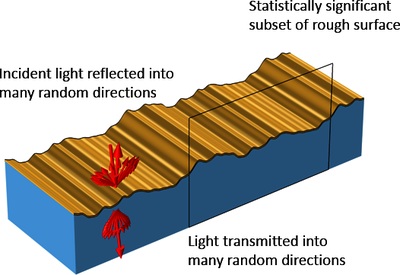
These examples demonstrate how to compute the total reflection, transmission, and absorption of light when a plane wave, at optical wavelengths, is incident upon a dielectric slab with a thin metal coating. Three examples are included that show: An optically flat slab A slab with a ... Read More
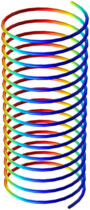
This model computes the trajectory of an ion in a uniform magnetic field using the Newtonian, Lagrangian and Hamiltonian formulations available in the Mathematical Particle Tracing interface. Read More
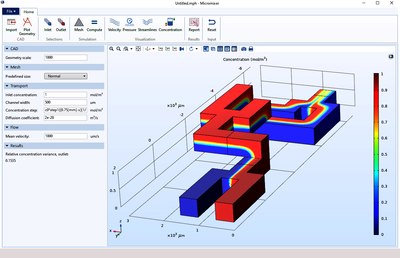
This app simulates a micromixer based on an imported CAD geometry. The app shows how you can use the Application Builder to build an app that can handle CAD import and let the user interactively select boundary conditions. The app shows how this can be done without any programming using ... Read More
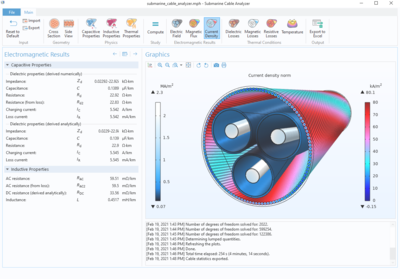
This application demonstrates how the Application Builder in the COMSOL Multiphysics® software can be used to make advanced cable modeling available to a general audience. At its core is a multiphysics model based on the technology introduced in the Cable Tutorial Series. The ... Read More
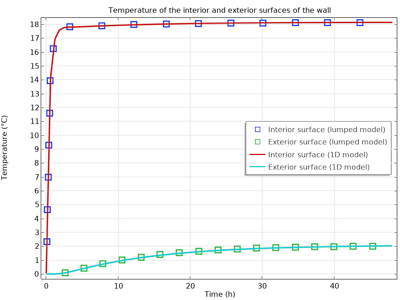
This model performs a transient analysis of the temperature through a house wall. The wall is formed of different layers corresponding to the structure, insulation and plaster. On the exterior and the interior, the wall is exposed to thermal radiation and convective cooling. The results ... Read More
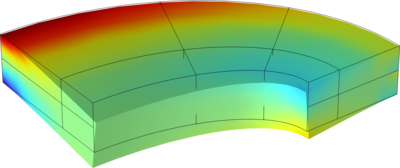
A benchmark model where a thick plate exposed to pressure on the top surface is analyzed. The solution is compared with a NAFEMS benchmark solution. Read More

Optical computing has been a promising paradigm alternative to the current electronic computers. This model simulates an optical 4-by-4 unitary matrix multiplication device based on a network of six Mach–Zehnder interferometers (MZIs). A more detailed description of this model can be ... Read More
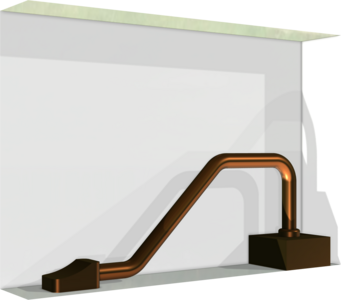
This model analyzes Joule heating and thermal expansion in a bond wire in an LED. Its purpose is to estimate the temperature increase and the resulting mechanical stresses in the bond wire due to thermal expansion. The magnitude of these stresses can be used to assess the risk of fatigue ... Read More


