
The Application Gallery features COMSOL Multiphysics® tutorial and demo app files pertinent to the electrical, structural, acoustics, fluid, heat, and chemical disciplines. You can use these examples as a starting point for your own simulation work by downloading the tutorial model or demo app file and its accompanying instructions.
Search for tutorials and apps relevant to your area of expertise via the Quick Search feature. Note that many of the examples featured here can also be accessed via the Application Libraries that are built into the COMSOL Multiphysics® software and available from the File menu.

This tutorial models the intercoupled electrochemical reactions, charge and species transport as well as heat transfer in a polymer electrolyte membrane (PEM) fuel cell. For the gas flow fields, straight channels are used on the hydrogen anode side, whereas a mesh structure is used on ... Read More
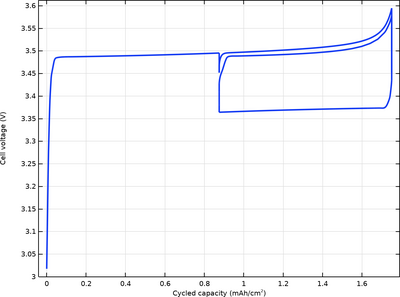
Lithium iron phosphate (LFP) is a common positive electrode material in lithium-ion batteries. Specific for the LFP electrode material is that its equilibrium (open circuit) potential, when defined as a function of the lithiation state, features a large flat plateau with a more or less ... Read More
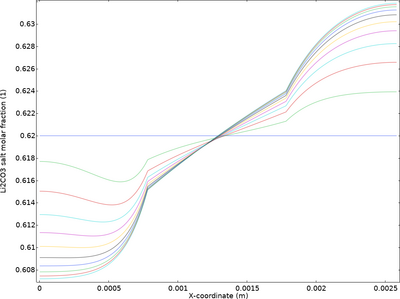
This tutorial shows how to model transport of the individual ions in a salt melt comprising two binary salts, where the transport equations are defined using concentrated solution theory. The example model defines a molten carbonate fuel cell (or electrolyzer), with a 1D-model geometry ... Read More
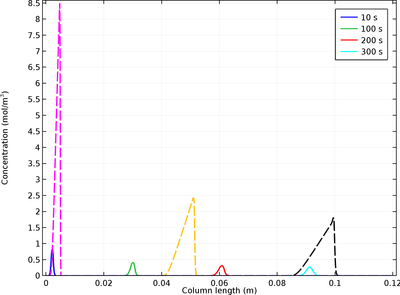
High-performance liquid chromatography (HPLC) is a common method of separating, identifying, and quantifying each chemical compound in a mixture. HPLC is found in the pharmaceutical, biotech, and food industries. The Liquid Chromatography app simulates the separation of two species ... Read More

This model example investigates the transport of reactants and water in a high temperature PEMFC. The model includes mass and momentum transport phenomena in the flow channels, gas diffusion layers (GDLs), and porous electrodes, as well as electrochemical currents in the GDLs, the porous ... Read More
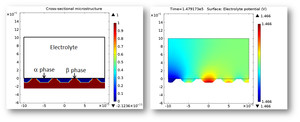
Galvanic corrosion between two different phases (alpha and beta phases) in a metallic (magnesium) alloy is simulated for a representative cross-sectional microstructure configuration. A key feature in the model formulation is the implementation of both anodic and cathodic regions at ... Read More
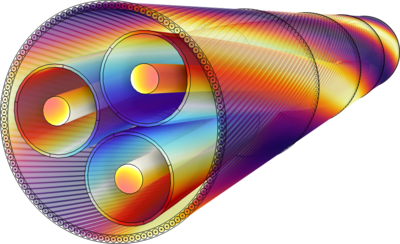
In this set of eight tutorial models and associated documentation, you can investigate the resistive, capacitive, inductive, and thermal properties of a standard three-core lead-sheathed XLPE HVAC submarine cable with twisted magnetic armor (500 mm2, 220 kV). The series includes a 2D, 2D ... Read More
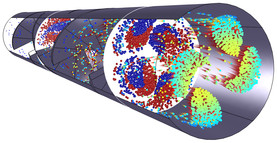
In static mixers, also called motionless or in-line mixers, a fluid is pumped through a pipe containing stationary blades. This mixing technique is particularly well suited for laminar flow mixing because it generates only small pressure losses in this flow regime. This example studies ... Read More

Metal hydride tanks offer safe hydrogen storage, thanks to their low reactivity, and a relatively high hydrogen density. When developing metal hydride hydrogen tank designs, modeling and simulation is useful for optimizing operating conditions, such as gas composition, pressure, and ... Read More
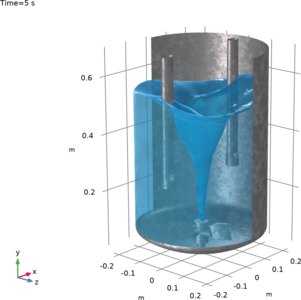
This example of turbulent flow in a partially baffled turbulent mixer with a three-bladed impeller shows how to set up the Rotating Machinery, Turbulent Flow interfaces from the Mixer Module with a Level Set method for free surface flow in a rotating geometry. A time-dependent simulation ... Read More