
The Application Gallery features COMSOL Multiphysics® tutorial and demo app files pertinent to the electrical, structural, acoustics, fluid, heat, and chemical disciplines. You can use these examples as a starting point for your own simulation work by downloading the tutorial model or demo app file and its accompanying instructions.
Search for tutorials and apps relevant to your area of expertise via the Quick Search feature. Note that many of the examples featured here can also be accessed via the Application Libraries that are built into the COMSOL Multiphysics® software and available from the File menu.
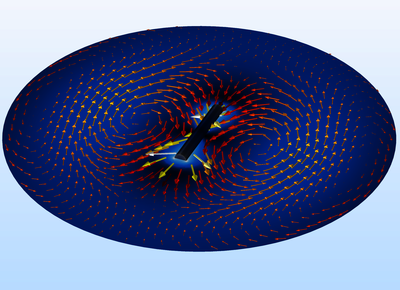
A metallic cylindrical rod is hidden inside a spherical dielectric shell and its orientation is unknown. By studying the polarization-dependent scattered field of a cylindrical object and performing a parametric sweep as a function of polarization angle, the rod is detected for the ... Read More
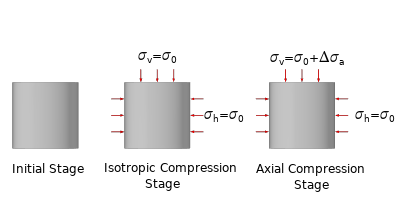
In this example, monotonic and cyclic triaxial tests are simulated using the Hardening Soil Small Strain material model. The model captures the effects of small strain stiffness and hysteresis under cyclic loading. The stress-strain relationship matches the hyperbolic curve reported in ... Read More
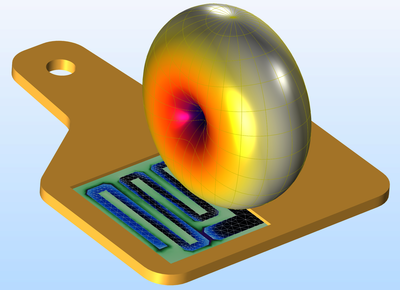
UHF RFID tags are widely used for identifying and tracking animals. This model simulates a passive radio-frequency identification (RFID) tag for the UHF frequency range. With respect to the chip transponder’s complex impedance, a reflection coefficient is computed. This is done using an ... Read More
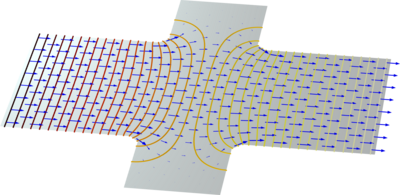
This example uses the Electric Currents in Layered Shells interface and the Layered Shell interface to model a piezoresistive pressure sensor. The tutorial considers the design of the MPX100 series pressure sensors originally manufactured by Motorola Inc. Although the sensor is no ... Read More
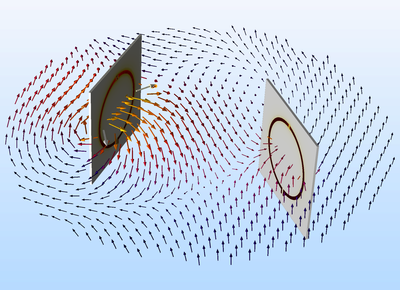
This model addresses the concept of wireless power transfer by studying the energy coupling between two circular loop antennas tuned for UHF RFID frequency whose size is reduced using chip inductors. The circular loop antenna provides inherent inductive coupling by its shape, and it can ... Read More
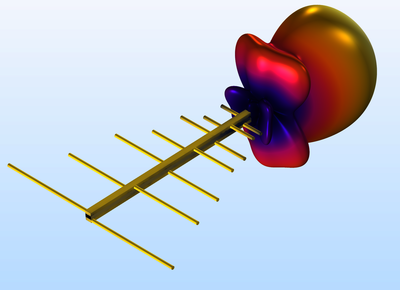
The shape of a log-periodic antenna resembles that of a Yagi-Uda antenna, but is composed of a coplanar array to achieve a wider bandwidth. It is also known as a wideband or frequency-independent antenna. All metallic parts are modeled using the perfect electric conductor (PEC) boundary ... Read More

Electrical cables, also called transmission lines, are used everywhere in the modern world to transmit both power and data. These cables carry electromagnetic energy, but instead of dealing with the full complexity of the electromagnetic fields, they are more commonly classified ... Read More
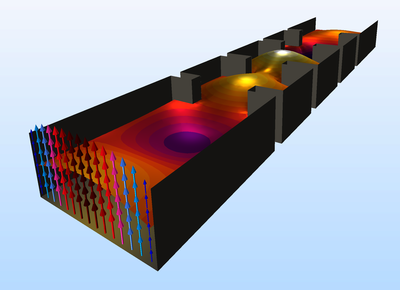
A conductive diaphragm, an iris, placed transverse to a waveguide aperture causes a discontinuity and generates shunt reactance. Bandpass frequency response can be achieved from cascaded cavity resonators combined with these reactive elements which can be created by inserting a series of ... Read More
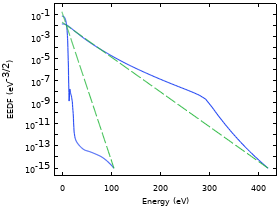
This tutorial models a DC glow discharge by solving fluid-type plasma equations fully coupled with the homogeneous and time-independent electron Boltzmann equation in the classical two-term approximation. The approximated Boltzmann equation is solved for each position of space and is ... Read More
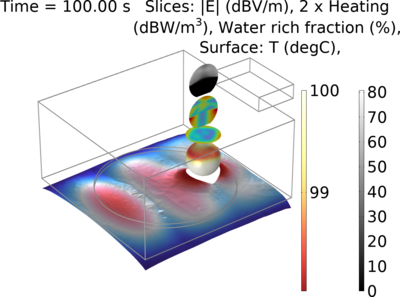
A spherical water-rich load (potato) is placed on the rotating glass tray of a microwave oven some distance from the center of rotation. 1 kW of 2.45 GHz microwave power is applied via a waveguide feed. The plate rotates at 9 degrees per second. The heat transfer model involves the ... Read More