
The Application Gallery features COMSOL Multiphysics® tutorial and demo app files pertinent to the electrical, structural, acoustics, fluid, heat, and chemical disciplines. You can use these examples as a starting point for your own simulation work by downloading the tutorial model or demo app file and its accompanying instructions.
Search for tutorials and apps relevant to your area of expertise via the Quick Search feature. Note that many of the examples featured here can also be accessed via the Application Libraries that are built into the COMSOL Multiphysics® software and available from the File menu.
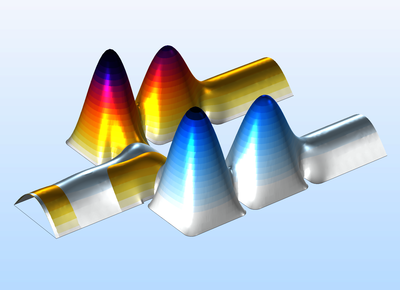
A diplexer is a device that combines or splits signals into two different frequency bands, widely used in mobile communication systems. This model simulates splitting properties using a simplified 2D geometry. The computed S-parameters and electric fields at the lower and upper bands ... Read More
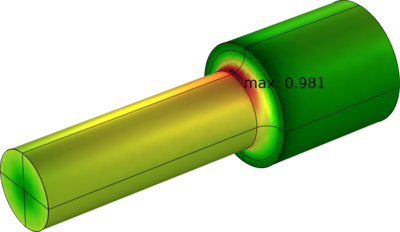
This example shows how to perform a High Cycle Fatigue (HCF) analysis with a non-proportional load history caused by a transversal force and a torque which are applied in different combinations. Three different fatigue models (Findley, Matake, and Dang Van) are compared. Read More
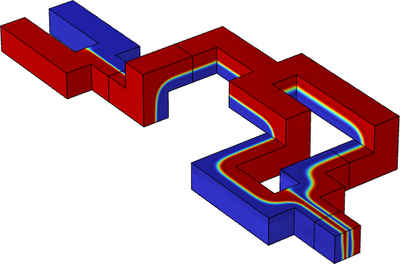
This example models a split-and-recombine mixer channel in which a tracer fluid is introduced and mixed by multilamination. Diffusion is removed from the model using an extremely low diffusion coefficient so that any numerical diffusion can be studied in the lamination interfaces. The ... Read More
A gate-all-around MOSFET consists of a nanowire with a gate electrode wrapped around the circumference. Since the entire nanowire forms the channel, this configuration provides the best possible electrostatic control of the channel and offers a good candidate for the miniaturization of ... Read More

Not all analysis projects start with a CAD model. Sometimes the only data you have available is a set of points, also known as a point cloud. The examples files available here illustrate how point cloud data can be converted to geometry models that can be used for simulation in the ... Read More

This model demonstrates how to compute the acoustic properties of an acoustic liner with a grazing flow. The liner consists of eight resonators with thin slits. The background grazing flow is at Mach number 0.3. The sound pressure level above the liner is computed and can be compared to ... Read More
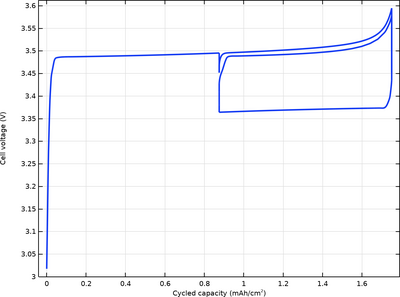
Lithium iron phosphate (LFP) is a common positive electrode material in lithium-ion batteries. Specific for the LFP electrode material is that its equilibrium (open circuit) potential, when defined as a function of the lithiation state, features a large flat plateau with a more or less ... Read More
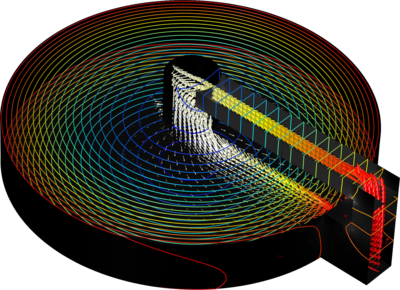
A homopolar generator is composed of an electrically conductive rotating disc placed in a uniform magnetic field that is perpendicular to the plane of rotation. The motion of the conductor through the static magnetic field induces Lorentz currents in the disc. By connecting the outside ... Read More


