
The Application Gallery features COMSOL Multiphysics® tutorial and demo app files pertinent to the electrical, structural, acoustics, fluid, heat, and chemical disciplines. You can use these examples as a starting point for your own simulation work by downloading the tutorial model or demo app file and its accompanying instructions.
Search for tutorials and apps relevant to your area of expertise via the Quick Search feature. Note that many of the examples featured here can also be accessed via the Application Libraries that are built into the COMSOL Multiphysics® software and available from the File menu.
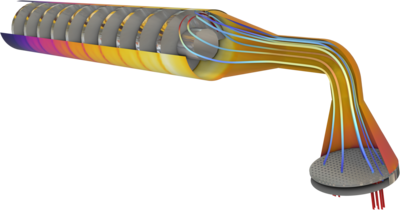
This tutorial example of the pasta extrusion process shows how to simulate the non-isothermal flow of dough in the metering zone of a pasta extruder accounting for the temperature dependent material properties of the hydrated semolina dough. Read More
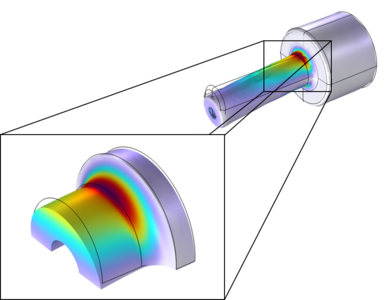
This model shows how to perform a submodeling analysis in order to evaluate structural stress. Using a submodel helps to compute the results in a refined geometry detail while applying loads and constraints in the global model. Read More
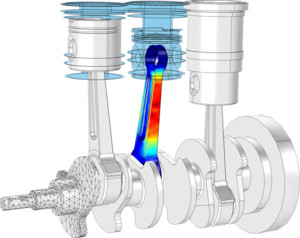
In this example, a dynamic analysis of a three-cylinder reciprocating engine is performed to investigate stresses generated during operation, thereby permitting identification of the critical components. Demand for high power output relative to the weight of the engine requires careful ... Read More
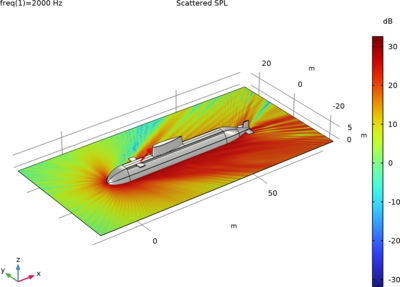
The primary defense of a submarine lies in its capacity to remain hidden during operation. As radio waves are strongly absorbed by sea water, sound navigation ranging, or SONAR, is one of the main methods used for the detection of submarines. SONAR systems are also used for underwater ... Read More
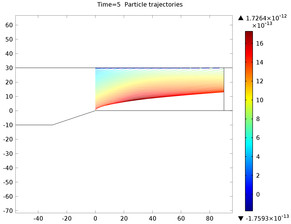
When a temperature gradient in a gas exists, suspended particles will tend to move from regions of high temperature to low. The force which produces this effect is called the thermophoretic force. Gas molecules colliding with a particle from the hot side have a higher velocity than the ... Read More
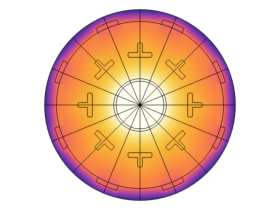
This model illustrates an application that maximizes surface-to-surface radiative fluxes and minimizes conductive heat fluxes. A thermo-photo-voltaic (TPV) cell generates electricity from the combustion of fuel and through radiation. The fuel burns inside an emitting device that ... Read More
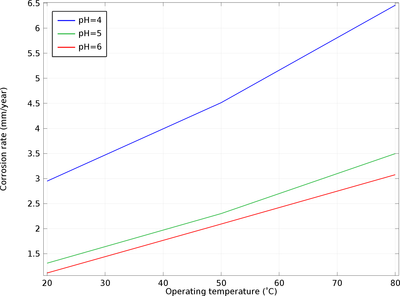
Carbon dioxide in aqueous solution is highly corrosive and can cause significant damage to steel designs. Such conditions arise in pipes used in a variety of applications, especially within the petrochemical industry. In this tutorial example, turbulent flows consisting of carbon ... Read More
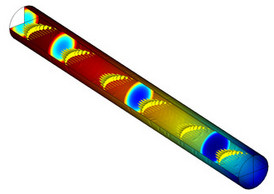
Tubular reactors are often used in continuous large-scale production, for example in the petroleum industry. One key design parameter is the conversion, or the amount of reactant that reacts to form the desired product. In order to achieve high conversion, process engineers optimize the ... Read More
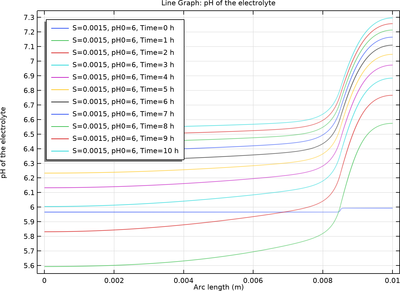
The model simulates atmospheric corrosion of a galvanic couple, comprising of an Al-Co-Ce metallic coating and an aluminum alloy, which is in contact with electrolyte film of 100 micrometer thickness. The corrosion inhibitors are released from the metallic coating and are transported ... Read More
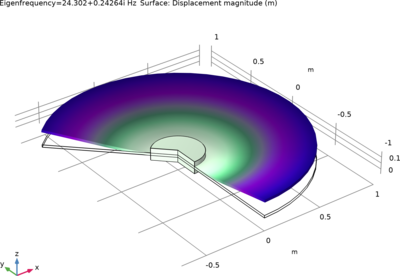
This model illustrates how to perform prestressed eigenfrequency and frequency response analyses in a contact problem. A circular plate is squeezed between two thicker plates. The peak of the prestressed frequency response analysis is compared with the prestressed eigenfrequencies as ... Read More