
The Application Gallery features COMSOL Multiphysics® tutorial and demo app files pertinent to the electrical, structural, acoustics, fluid, heat, and chemical disciplines. You can use these examples as a starting point for your own simulation work by downloading the tutorial model or demo app file and its accompanying instructions.
Search for tutorials and apps relevant to your area of expertise via the Quick Search feature. Note that many of the examples featured here can also be accessed via the Application Libraries that are built into the COMSOL Multiphysics® software and available from the File menu.
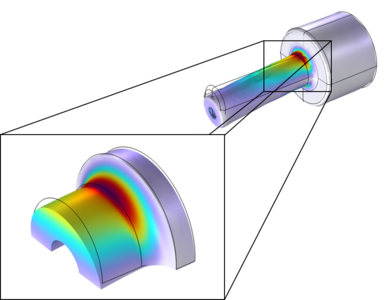
This model shows how to perform a submodeling analysis in order to evaluate structural stress. Using a submodel helps to compute the results in a refined geometry detail while applying loads and constraints in the global model. Read More
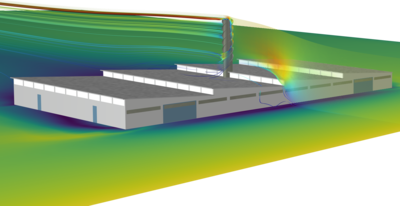
Wind strakes on a chimney impede the uniform detachment along the height of the chimney, which can induce vibrations and eventually lead to fatigue at the footing of the chimney. A stationary turbulent flow simulation is computed for a chimney with strakes mounted on a factory building. ... Read More
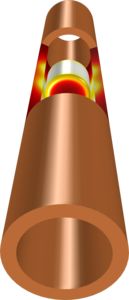
A cylindrical magnet falling through a copper tube induces eddy currents on the tube walls, which in turn, create a magnetic field that opposes the magnetic field of the magnet and induces a braking force that opposes the motion of the magnet. This model computes the velocity of the ... Read More
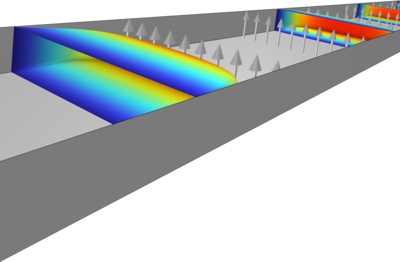
In nuclear fusion reactors, the conducting fluid, such as the fusion plasma and the liquid metal in the reactor blanket, will interact with the background magnetic field. This phenomenon is referred to as magnetohydrodynamics (MHD). The electromagnetic field and fluid flow are fully ... Read More
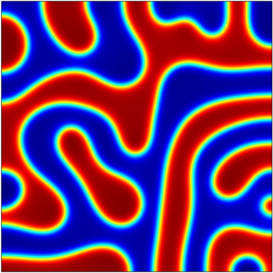
Phase separation occurs when a binary system is quenched from its stable, homogeneous one-phase state into the two-phase region of its phase diagram. The spontaneous separation of two immiscible fluids is sometimes referred to as spinodal decomposition. Each phase tends to separate into ... Read More
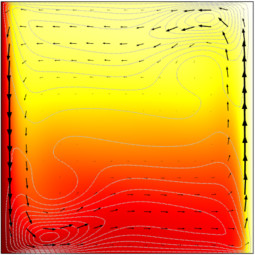
This model couples the Navier Stokes equations and the heat transfer equations to examine density driven flow of free fluids. Here the fluid is in a square cavity with a heated wall. The buoyancy force is a Boussinesq term added to the Navier-Stokes equations. The equation is ... Read More
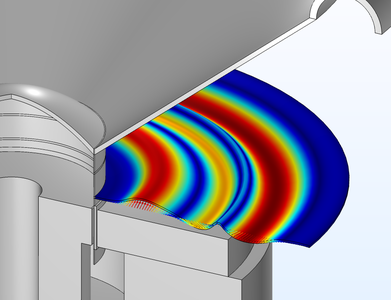
The suspension of a loudspeaker is designed to keep the membrane in place and avoid any rocking movement of the voice coil. At low frequencies, where the displacement of the membrane is significant, the stiffness of the suspension varies along the movement of the voice coil. This ... Read More
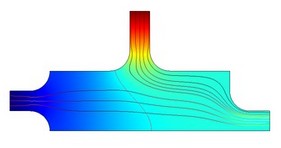
This model shows how a flow model can be coupled to a process control mechanism. Controlling application parameters according to other application parameters is important within process engineering. Most control mechanisms use the data at a wall or an outlet to control inlet ... Read More
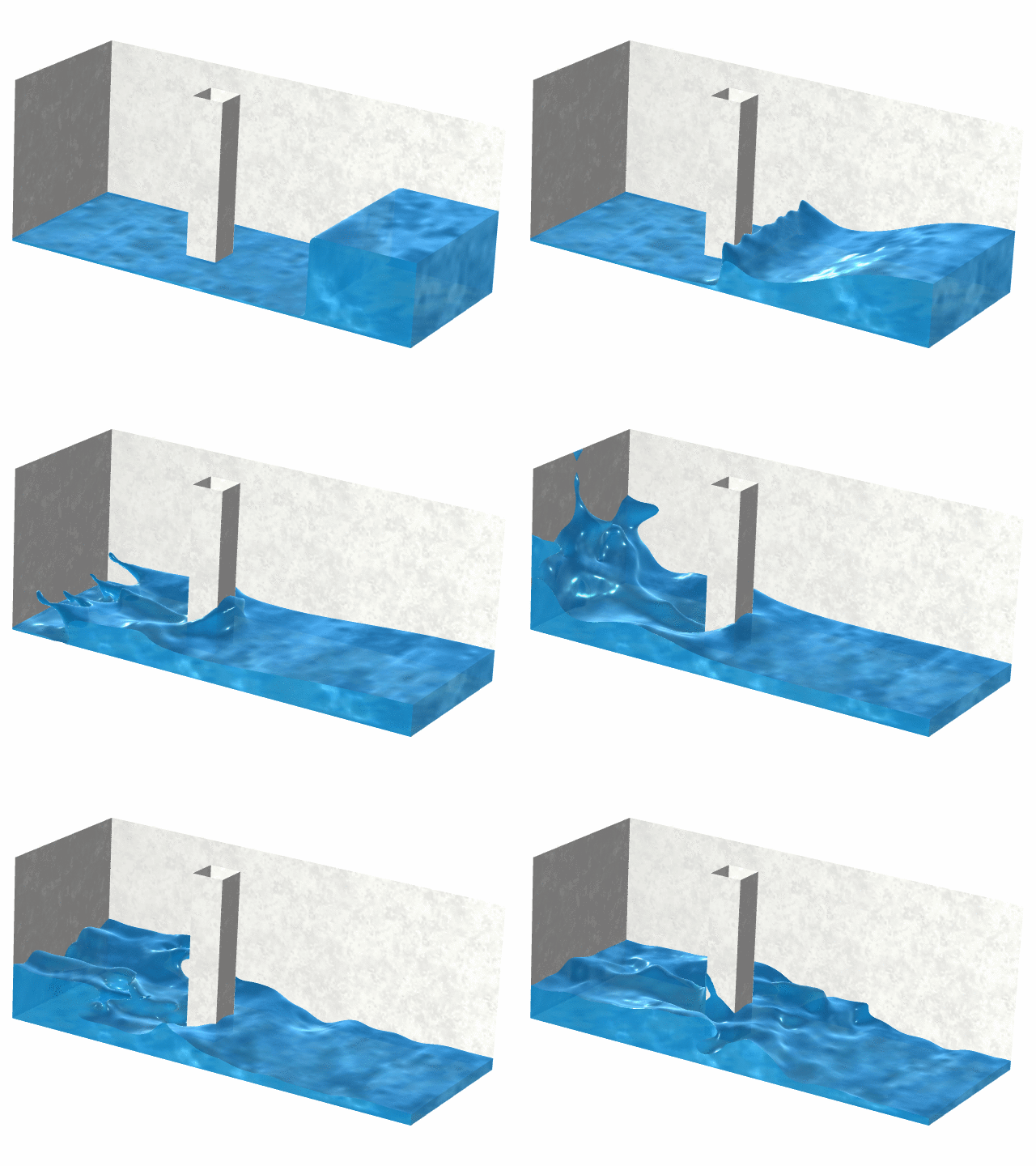
This transient model uses the Two-Phase Flow, Level Set, Laminar Flow interface to model the impact of a water wave on a column. A body of water with a height of 0.3 meters is initially contained behind a gate. At the start of the simulation, the gate is suddenly released and the body of ... Read More
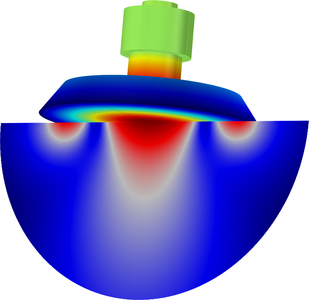
A tonpilz transducer is used for relatively low frequency, high power sound emission. It is one of the popular transducer configurations for SONAR applications. The transducer consists of piezoceramic rings stacked between a head mass and a tail mass which are connected by a central ... Read More


