
The Application Gallery features COMSOL Multiphysics® tutorial and demo app files pertinent to the electrical, structural, acoustics, fluid, heat, and chemical disciplines. You can use these examples as a starting point for your own simulation work by downloading the tutorial model or demo app file and its accompanying instructions.
Search for tutorials and apps relevant to your area of expertise via the Quick Search feature. Note that many of the examples featured here can also be accessed via the Application Libraries that are built into the COMSOL Multiphysics® software and available from the File menu.
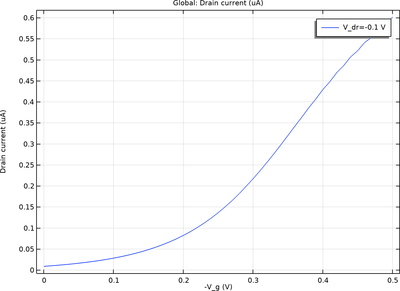
This model shows how to model an electrolyte-gated organic field-effect transistor based on a general drift–diffusion model. The model uses the Transport of Charge Carriers interface and the Electrostatics interface. The transistor characteristics are visualized. Formation of the EDLs in ... Read More
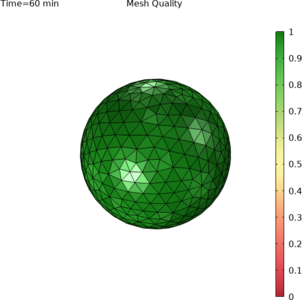
Droplet evaporation is ubiquitous in everyday life and is essential in many industrial processes, such as inkjet printing, cleaning/coating of surfaces, and phase change heat transfer. This model demonstrates how to model phase transition by a moving exterior boundary condition using ... Read More

This thermo-hydro-mechanical (THM) model of artificial ground freezing couples heat transfer, groundwater flow, and soil mechanics to capture ice formation, pore-pressure changes, and ground deformation during tunnel excavation. The freezing process is modeled with the apparent heat ... Read More
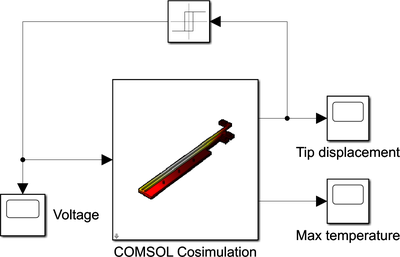
This example model consists of a two-hot-arm thermal actuator made of polysilicon. The actuator is activated through thermal expansion. The temperature increase required to deform the arms, and thus displace the actuator, is obtained through Joule heating (resistive heating). The greater ... Read More
This is a template base model containing the physics, geometry and mesh of a lithium-ion battery, defined in 1D. The model makes use of four lithiation parameters which are used to define the relative balancing of the negative and positive electrodes, as well as global cell state of ... Read More
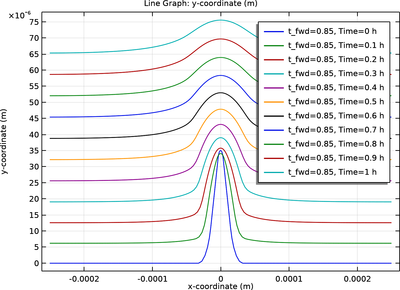
This tutorial explores how pulse reverse plating can be used as an additive-free alternative to attenuate small protrusions during copper metal deposition. By matching the process parameters, including the length of the forward and reverse pulses (duty cycles), a bright mirror-like metal ... Read More

This is a template MPH-file containing the physics interfaces and the parameterized geometry for the model Electrical Heating in a Busbar. Read More
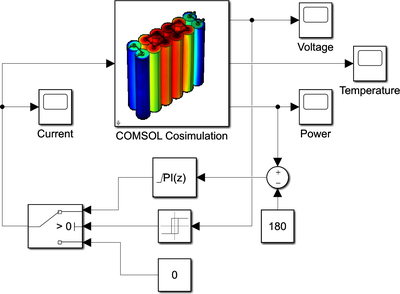
This model computes the temperature distribution in a battery pack that is in use at a specified power. The current is controlled in Simulink® to ensure constant power during usage. Read More
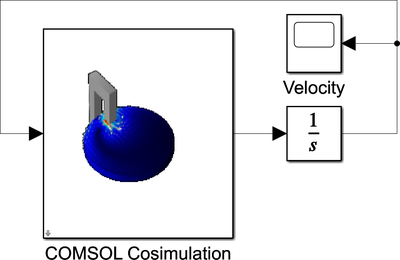
A magnetic brake consists of a permanent magnet, which induces currents in a rotating copper disk. The resulting eddy currents interact with the magnetic flux to produce Lorentz forces and subsequently a braking torque. The disk angular velocity is computed using Simulink®. Read More
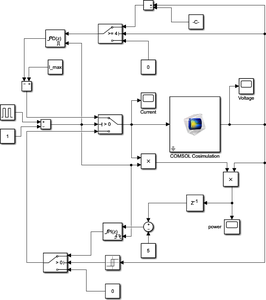
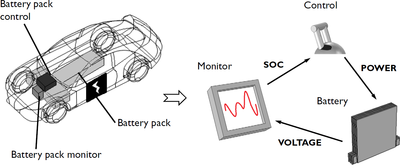
This model illustrates the charge/discharge control of a Lithium-Ion battery in a Simulink® simulation. Read More


