
The Application Gallery features COMSOL Multiphysics® tutorial and demo app files pertinent to the electrical, structural, acoustics, fluid, heat, and chemical disciplines. You can use these examples as a starting point for your own simulation work by downloading the tutorial model or demo app file and its accompanying instructions.
Search for tutorials and apps relevant to your area of expertise via the Quick Search feature. Note that many of the examples featured here can also be accessed via the Application Libraries that are built into the COMSOL Multiphysics® software and available from the File menu.

Dialysis is a widely used chemical species separation method. One such example is hemodialysis, which acts as artificial kidneys for people with renal failure. In dialysis, only specific components are allowed to diffuse through the membrane, based on differences in molecular size and ... Read More
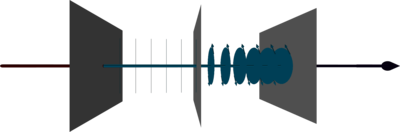
Combinations of optical devices such as polarizers and wave retarders can be used to control the intensity and polarization of transmitted radiation. In this tutorial, two linear polarizers with orthogonal transmission axes are used to reduce the intensity of a ray to zero. Then the ... Read More

Nanoparticles have become widely used in a range of applications. For example, in pharmaceuticals, particles on the nanoscale, such as nanocrystals, are often used as an effective means of drug delivery. Meanwhile in material sciences, nanoparticle coating is an increasingly common way ... Read More
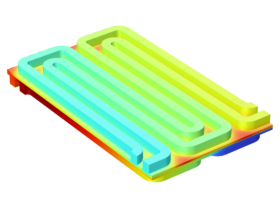
This tutorial explores the current distribution in a low-temperature PEMFC when using serpentine-based flow field patterns. The cell is operated in counter-flow mode so that the oxygen and hydrogen inlet flow streams are located at opposite sides. Relatively dry inlet gas compositions ... Read More
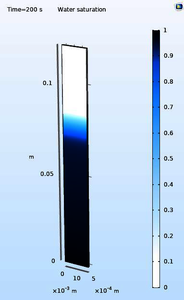
This example models wicking in a porous medium. Wicking is the phenomenon that occurs when a dry porous material is put into contact with a fluid: it will absorb the fluid due to capillary forces. The absorption will continue until an equilibrium is reached where the gravitational forces ... Read More
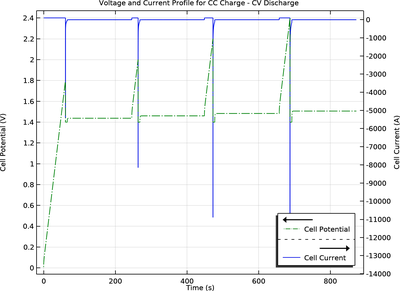
Electrochemical supercapacitors feature relatively higher energy densities than conventional capacitors. With several advantages, such as fast charging, long charge–discharge cycles, and broad operating temperature ranges, electrochemical supercapacitors have found wide applications in ... Read More

This model demonstrates how to set up a fully coupled poroviscoelastic model of biological tissues. The model is benchmarked by simulating a cyclic uniaxial tension–compression test on human brain tissue. Read More
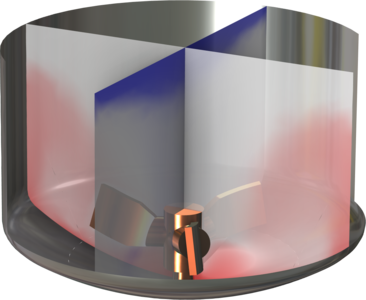
This model simulates the separation and mixing of a suspension with light and heavy particles. Initially the distribution of both particle populations is homogeneous throughout the fluid. Before the impeller starts rotating, the fluid and the two particle populations tend to separate ... Read More
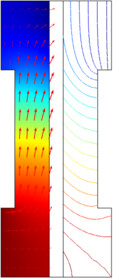
This example focuses on the species transport within the gas diffusion layers (GDLs) of a proton exchange membrane (PEM) fuel cell. The geometry models a cell with two adjacent flow channels of different pressures, a situation that may occur in a cell with serpentine flow channels, or in ... Read More

This example describes an array of heating tubes submerged in a vessel with fluid flow entering at the bottom. This is a multiphysics model because it involves fluid dynamics coupled with heat transfer. The pressure and the velocity field are the solution of the Navier-Stokes equations, ... Read More


