
The Application Gallery features COMSOL Multiphysics® tutorial and demo app files pertinent to the electrical, structural, acoustics, fluid, heat, and chemical disciplines. You can use these examples as a starting point for your own simulation work by downloading the tutorial model or demo app file and its accompanying instructions.
Search for tutorials and apps relevant to your area of expertise via the Quick Search feature. Note that many of the examples featured here can also be accessed via the Application Libraries that are built into the COMSOL Multiphysics® software and available from the File menu.
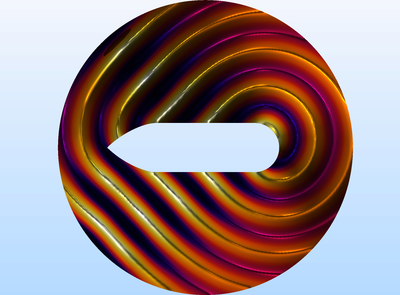
This tutorial model demonstrates the use of a background field in an electromagnetic scattering problem. Although this example is a boat hit by a radar, this same technique can be used in any situation where an isolated object meets electromagnetic waves from a distant source. For ... Read More
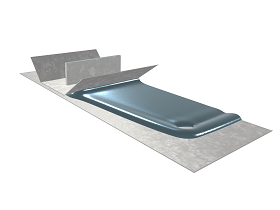
This is a tutorial of a slot die coating process in 3D where the channel is obstructed. The example uses a two-phase flow phase-field method with a non-Newtonian power-law fluid. The effects on the film thickness of the channel obstruction can clearly be seen. Read More
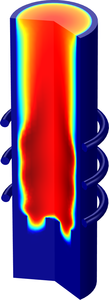
This model investigates the electrical and thermal characteristics of an inductively coupled plasma torch at atmospheric pressure. The discharge is assumed to be in local thermodynamic equilibrium. Read More
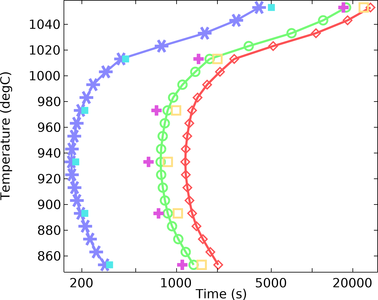
This model shows how to use the Metal Processing Module and the Optimization Module to calibrate parameters of a phase transformation model against TTT (Time Temperature Transformation) data. Read More

The design of antireflective coating plays an important role to increase the transmission of the infrared light that propagates through optical structures such as lens and windows. In this model, we showcase how different bulk structures such as Si and CZT that has the bulk ... Read More
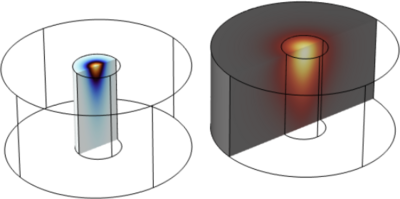
This model demonstrates how to couple the Radiative Beam in Absorbing Media interface to the Radiation in Absorbing-Scattering Media interface. To learn more about this model, see our accompanying blog post “Modeling Absorption and Scattering of Collimated Light”. Read More
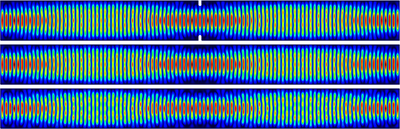
This model demonstrates three different ways to find the eigenfrequencies of a rectangular metallic cavity. The first method uses an eigenfrequency study step together with the Electromagnetic Waves, Beam Envelopes interface. Here, it is important to define a wave vector for the physics ... Read More
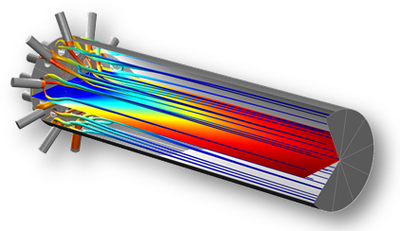
In a polymerization reactor for polyester manufacturing, the mixing in the reactor is achieved by impinging turbulent jets of reactants onto each other. The turbulence affects the reaction kinetics and quality of the polymer linkage. Turbulent flows involving rapid reaction kinetics are ... Read More
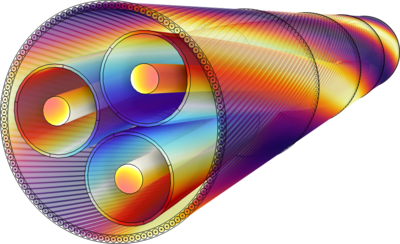
In this set of eight tutorial models and associated documentation, you can investigate the resistive, capacitive, inductive, and thermal properties of a standard three-core lead-sheathed XLPE HVAC submarine cable with twisted magnetic armor (500 mm2, 220 kV). The series includes a 2D, 2D ... Read More
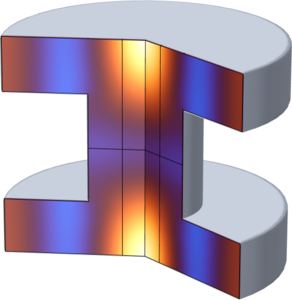
This is a model of a simple photoacoustic (or optoacoustic) resonator. A pulsating laser heats a gas causing expansion and contraction and thus creates pressure waves. Such devices are used as sensors for measuring material parameters of the gas inside the resonator. The resonance ... Read More