
The Application Gallery features COMSOL Multiphysics® tutorial and demo app files pertinent to the electrical, structural, acoustics, fluid, heat, and chemical disciplines. You can use these examples as a starting point for your own simulation work by downloading the tutorial model or demo app file and its accompanying instructions.
Search for tutorials and apps relevant to your area of expertise via the Quick Search feature. Note that many of the examples featured here can also be accessed via the Application Libraries that are built into the COMSOL Multiphysics® software and available from the File menu.
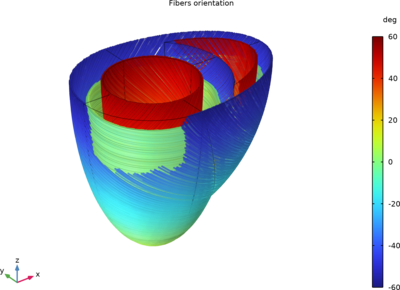
The standard biventricular cardiac model is used to show how to set up fiber directions in a complex geometry. The fibers are then used to model the large deformation of the myocardium with the Holzapfel-Gasser-Ogden anisotropic material model. The Aliev-Panfilov equations are included ... Read More
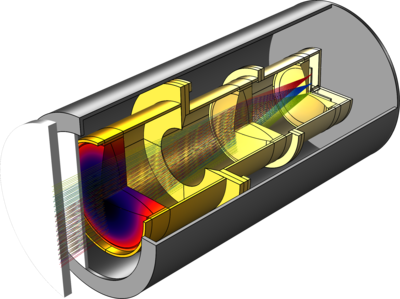
This model demonstrates an integrated structural-thermal-optical performance (STOP) analysis of an optical system. The Petzval Lens tutoral is used as the basis for this model, together with a simple barrel geometry The isothermal model performs a Parametric Sweep over several uniform ... Read More
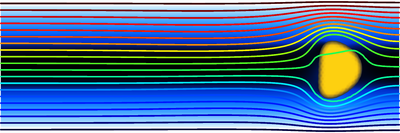
Applying an electric field across a suspension of immiscible liquids may stimulate droplets of the same phase to coalesce. The method known as electrocoalescence has important applications, for instance, in the separation of oil from water. To model electrocoalescence, you need to solve ... Read More
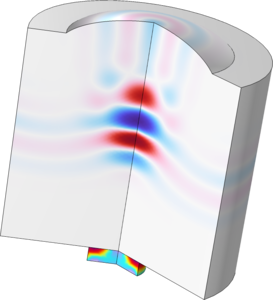
Piezoelectric devices are widely used as sources to generate sound waves or receivers to detect acoustic signals. In applications such as ultrasound imaging and nondestructive testing, the same transducer can be used as a transmitter to send a source signal and receiver to detect ... Read More
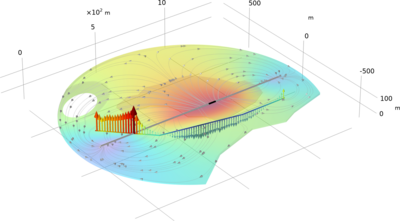
Light rail transit (LRT) systems often utilize DC power for train propulsion. In these systems the potential gradients in the rails may induce stray currents, which corrode adjacent metallic structures. In this example, the Cathodic Protection interface, using Edge Electrode nodes, is ... Read More
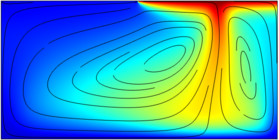
Density variations can initiate flow even in a still fluid. In earth systems, density variations can arise from naturally occurring salts, subsurface temperature changes, or migrating pollution. This buoyant or density-driven flow factors into fluid movement in salt-lake systems, saline ... Read More
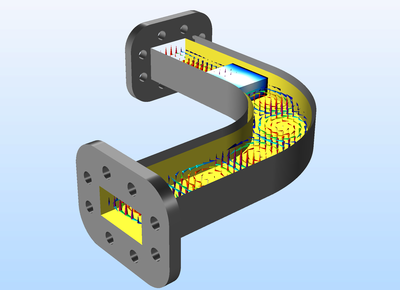
This is a model of an RF waveguide bend with a dielectric block inside. There are electromagnetic losses in the block as well as on the waveguide walls which cause the assembly to heat up over time. The material properties of the block are functions of temperature. The transient thermal ... Read More
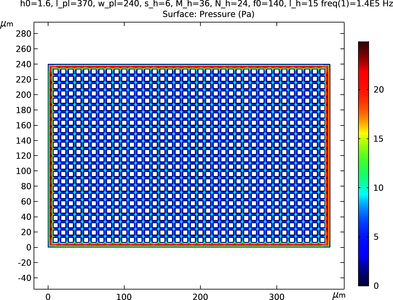
This benchmark model compares the damping coefficients of perforated plates from computation results versus experimental data. The simulation includes 18 different geometric configurations. It uses the Bao's perforation model, which is built-in in the Thin Film Flow physics interface. ... Read More
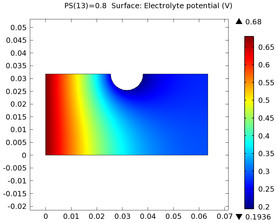
This example models cathodic protection of a steel reinforcing bar in concrete. Three different electrochemical reactions are considered on the steel surface. Charge and oxygen transport are modeled in the concrete domain, where the electrolyte conductivity and oxygen diffusivity depend ... Read More

This model analyzes the scattering of a plane propagating modulated Gaussian pulse off a submarine hull. The scattered field and the spatial response are also determined. The model uses the Pressure Acoustics, Time Explicit interface to model this large acoustic model in the time domain. ... Read More