
The Application Gallery features COMSOL Multiphysics® tutorial and demo app files pertinent to the electrical, structural, acoustics, fluid, heat, and chemical disciplines. You can use these examples as a starting point for your own simulation work by downloading the tutorial model or demo app file and its accompanying instructions.
Search for tutorials and apps relevant to your area of expertise via the Quick Search feature. Note that many of the examples featured here can also be accessed via the Application Libraries that are built into the COMSOL Multiphysics® software and available from the File menu.
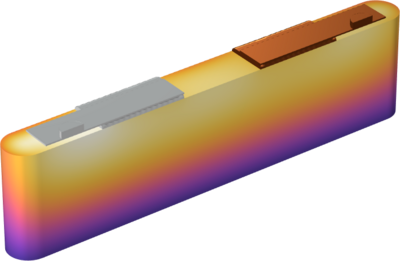
This model exemplifies how to compute the internal temperature distribution in a prismatic battery during a high-rate charge. The electrochemistry is described by a a lumped two-electrode model, which is coupled to the heat transfer model. The heat transfer model includes the effects of ... Read More
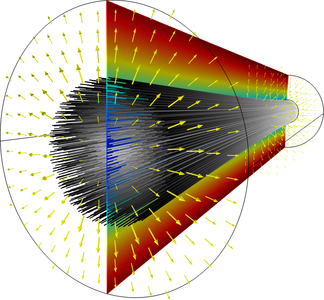
When modeling the propagation of charged particle beams at high currents, the space charge force generated by the beam significantly affects the trajectories of the charged particles. Perturbations to these trajectories, in turn, affect the space charge distribution. The Charged ... Read More

This example describes the cooling and solidification, from melt to solid metal, in a continuous casting process. The model includes nonisothermal properties, temperature distribution, flow field, and phase change. This example uses the arbritrary Lagrangian-Eulerian method for modeling ... Read More
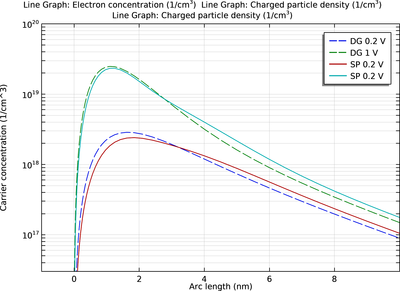
This tutorial demonstrates the use of the density-gradient formulation to include the effect of quantum confinement in the device physics simulation of a silicon inversion layer. This formulation requires only a moderate increase of computational resources as compared to the conventional ... Read More
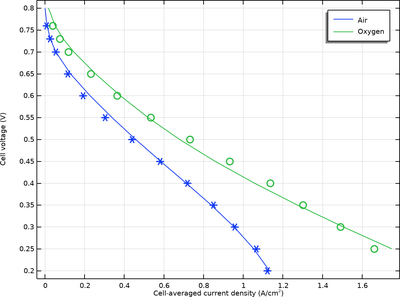
This tutorial demonstrates how to use stationary polarization data to perform parameter estimation of a polymer electrolyte membrane fuel cell (PEMFC) model. The model, defining a 5-layer membrane electrode assembly (MEA) is two-dimensional and includes electronic and ionic charge ... Read More
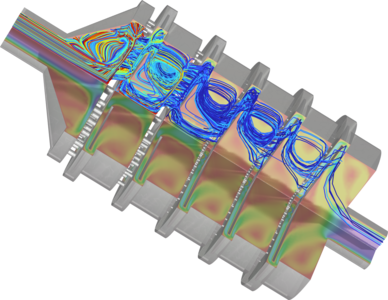
This example simulates particles in a range of sizes that move through different levels of a cascade impactor. A cascade impactor is an inertial particle separation device consisting of multiple levels separated by collecting plates and nozzles. Particle-laden air enters from the top ... Read More
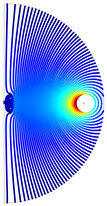
The mutual inductance and induced currents between a single turn primary and twenty turn secondary coil in a concentric coplanar arrangement is computed using a frequency domain model. The secondary coil is modeled using a homogenized approach which does not explicitly consider each turn ... Read More
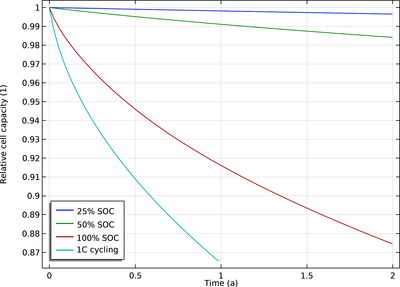
This tutorial demonstrates the Lumped Battery interface for modeling capacity loss in a battery. A set of lumped parameters are used to describe the capacity loss that occurs due to parasitic reactions in the battery, assuming no knowledge of the internal structure or design of the ... Read More
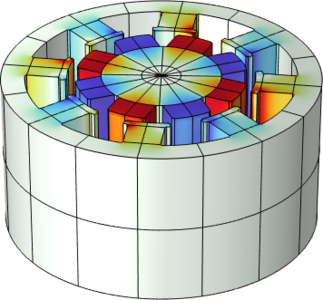
This application illustrates how to model an electric machine, such as a generator, motor, or drive, by exploiting its sector symmetry to reduce the size of the problem. The machine being studied is a simplified electric generator in 3D, based on the geometry used in the generator_2d ... Read More

Dialysis is a widely used chemical species separation method. One such example is hemodialysis, which acts as artificial kidneys for people with renal failure. In dialysis, only specific components are allowed to diffuse through the membrane, based on differences in molecular size and ... Read More