
The Application Gallery features COMSOL Multiphysics® tutorial and demo app files pertinent to the electrical, structural, acoustics, fluid, heat, and chemical disciplines. You can use these examples as a starting point for your own simulation work by downloading the tutorial model or demo app file and its accompanying instructions.
Search for tutorials and apps relevant to your area of expertise via the Quick Search feature. Note that many of the examples featured here can also be accessed via the Application Libraries that are built into the COMSOL Multiphysics® software and available from the File menu.
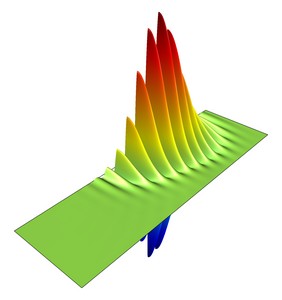
Laser systems are an important application area in modern electronics. With nonlinear materials it is possible to generate harmonics that are a multiple of the frequency of the laser light. This model shows how a second harmonic generation can be set up as a transient wave simulation, ... Read More
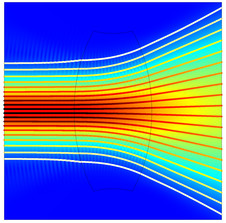
This example demonstrates how to set up a spatially varying dielectric distribution. Here, a convex lens shape is defined via a known deformation of a rectangular domain. The dielectric distribution is defined on the undeformed, original rectangular domain and is mapped onto the deformed ... Read More
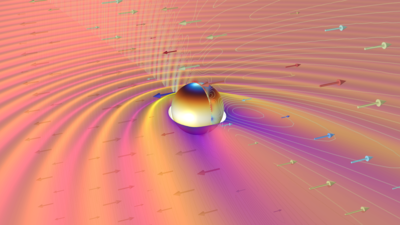
This verification model uses the Electromagnetic Waves, Boundary Elements interface to simulate the RCS of perfectly conducting sphere. The simulated result is compared to analytical calculation to verify the accuracy. Read More
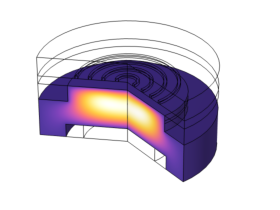
This tutorial model solves for an inductively coupled plasma reactor with RF bias (also known as ICP/CCP reactors) in a mixture of argon/chlorine. The model computes the fluid flow and gas heating. Important aspects and strategies for modeling electronegative discharges are discussed. Read More

This tutorial studies the etching of silicon using an inductively coupled plasma reactor with an RF bias in a mixture of CF4/O2. The etching rate is computed along the wafer as a function of the RF bias voltage. Read More
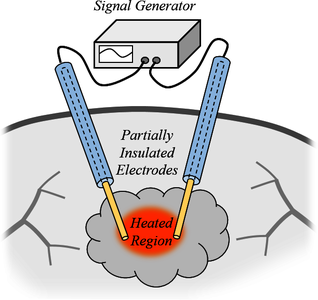
This example shows how to model tissue ablation through applying RF radiation. A more detailed description of the phenomenon and the modeling process can be seen in the blog post "Study Radiofrequency Tissue Ablation Using Simulation". Read More
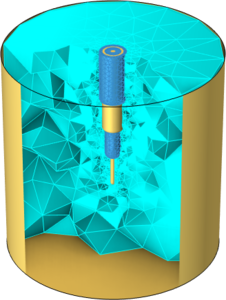
This model compares the results of five different formulations and approaches to solving an RF heating problem consisting of a coaxial cable inserted into a sample of lossy dielectric material. Results show that the different formulations agree over a wide frequency band. To learn more ... Read More
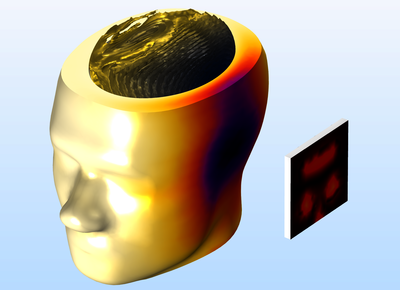
Users of consumer electronics with radiating devices are exposed to radio frequency (RF) emission. The amount of exposure is defined as the specific absorption rate (SAR). That is, the SAR value represents the radio frequency (RF) energy rate absorbed by a body. This model computes local ... Read More
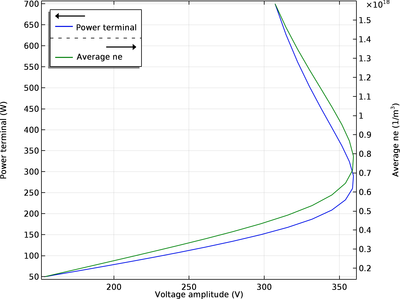
Capacitively coupled RF discharges can operate in two distinct regimes depending on the discharge power. In the low power regime, known as the alpha regime, the electric field oscillation is responsible to heat and create electrons. In the high power regime, known as gamma regime, the ... Read More
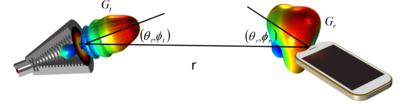
Multiscale modeling is a challenging issue in modern simulation. This occurs when there are vastly different scales in the same model. For example, your cell phone is approximately 10 cm, yet it receives GPS information from satellites 20,000 km away. In these models we examine several ... Read More